The Unsettled Canvas: How Migration Is Redrawing British Art

There’s a stubborn, almost charming belief that a nation’s art springs directly from its soil—pure, uninterrupted, a clear line of descent. Britain has never worked that way, and its contemporary art scene makes the fantasy look ridiculous. Walk through any major gallery or scan the Turner Prize lists of the past twenty years, and you’ll see a visual language in constant, productive upheaval. The real story isn’t a stable identity preening in the mirror. It’s rupture, translation, and the sharp, often uncomfortable insights that come from standing between worlds.

‘British art’ now is largely made by artists who’ve navigated multiple cultural frameworks. This isn’t about ticking a diversity box or sprinkling new faces onto an old canon. It’s a fundamental renegotiation of what the art is about. The old obsessions—a sometimes parochial dance with landscape and class—have given way to a tougher interrogation of belonging, memory, and the very mechanics of looking. The migrant artist doesn’t just bring fresh subject matter. They bring a different set of questions, often posed with a formal boldness that rattles the complacent viewer.

The Gaze That Answers Back: Reframing the National Story

For centuries, the British establishment curated a flattering self-portrait through landscapes and society likenesses—a mirror held up to its own power. Migration shatters that mirror. Artists like Yinka Shonibare CBE don’t just critique empire; they rummage through its aesthetic attic, reupholstering the furniture with those ‘African’ Dutch wax fabrics that are themselves a tangled history of colonial trade. His headless mannequins, trussed in Victorian finery, aren’t a cheap joke. They’re a precise historical argument: the body of the nation was always a composite, its identity a performance stitched from global threads. The work refuses the lazy binary of coloniser and colonised, insisting on a messier, more honest genealogy.

This reframing reaches the landscape itself. The pastoral myth of the English countryside—green, pleasant, and quietly white—is a powerful fantasy of exclusion. Photographer Ingrid Pollard has spent decades pricking it. Her series Pastoral Interlude places a Black figure in the Lake District, a direct challenge to the unspoken racial coding of the rural. The images aren’t aggressive; they’re quietly, devastatingly matter-of-fact. A person stands by a drystone wall, by a lake. The dissonance is entirely in the viewer’s head, exposing the exclusionary stories we’ve swallowed whole. This is the migrant artist’s diagnostic gift: making visible the invisible structures of feeling that police who gets to belong where.

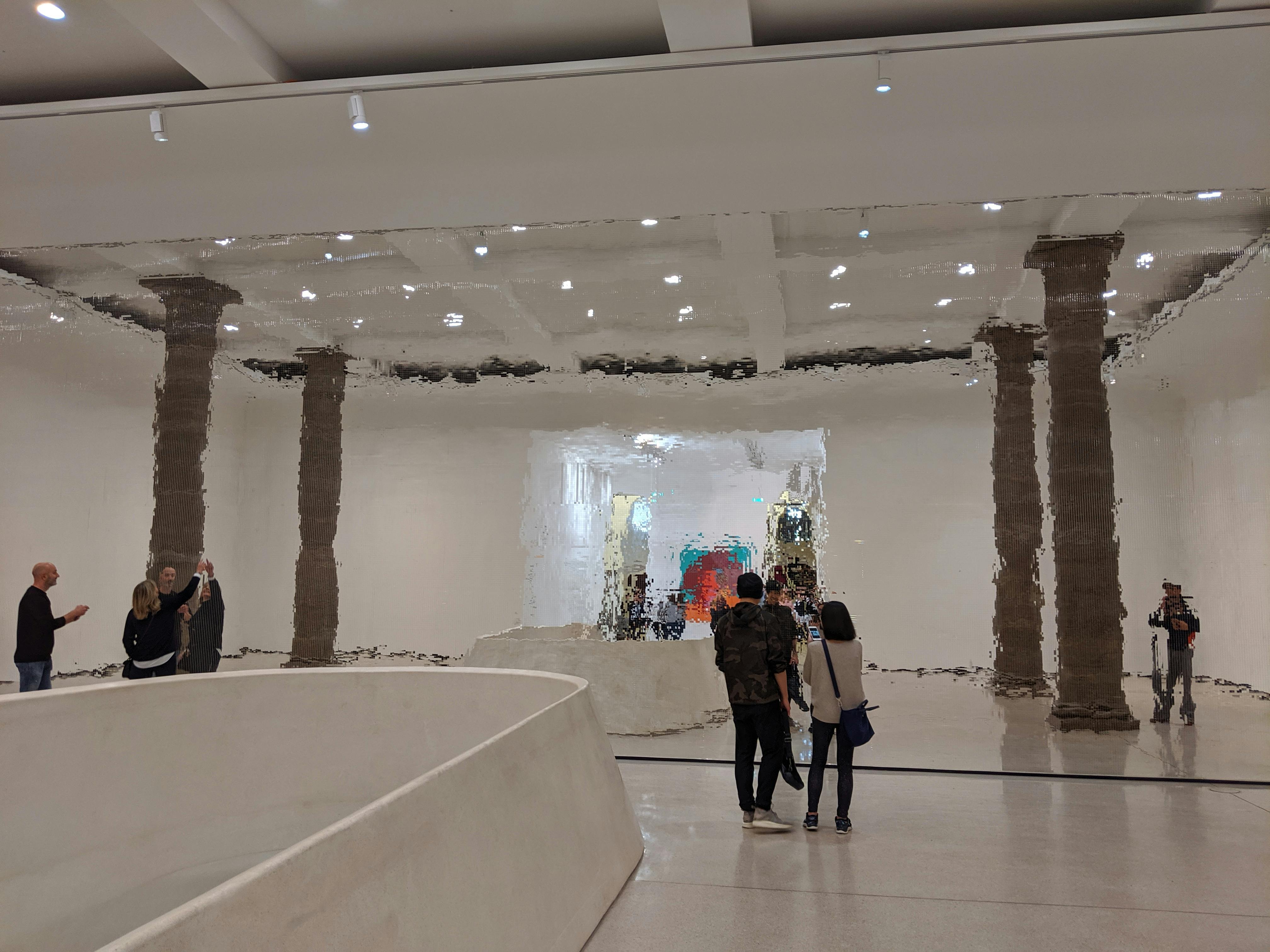
A person stands contemplatively before a large, colourful abstract painting in a gallery, reflecting the personal encounter with art that migration narratives often provoke.

The Aesthetics of Displacement: Memory as Raw Material

Migration isn’t a single event; it’s a condition. The physical journey is followed by a longer, more disorienting psychological one. The past becomes a foreign country in a double sense, and memory itself turns into a primary artistic material—unreliable, fragmentary, and often painful. This isn’t nostalgia. Nostalgia is a warm bath. The art of displacement is a cold shower, a face-to-face with loss, linguistic fracture, and the strange hybrid objects that emerge when one world collides with another.

Look at the work of Mona Hatoum. She takes the most domestic objects—a colander, a crib, a kitchen grater—and makes them threatening, scaling them up or rendering them in steel wire and lightbulbs. A simple grater becomes a menacing room divider. The domestic space turns unhomely, its promise of safety withdrawn. It speaks directly to exile, where the familiar is perpetually out of reach or transformed into something alien. The body is always implied, vulnerable and under threat, mapping a psychological geography of unease that outstrips any specific political border.

Similarly, the late Khadija Saye’s haunting wet-collodion tintypes, the Dwelling: in this space we breathe series, fused Gambian spiritual practices with her London upbringing. The self-portraits, made shortly before her death in the Grenfell Tower fire, aren’t a simple celebration of hybridity. They’re a profound meditation on breath as a vessel for trauma and memory, a search for a spiritual home that exists only in the fragile, alchemical moment of the photographic plate. The work shows how displacement can forge a visual language of extraordinary interior depth, speaking from a specific cultural crossroads to a universal need for sanctuary.

A person's hands gently holding a collection of old, black and white family photographs, symbolising the fragmented memories and personal archives central to migrant art.

The Politics of the Personal: Body, Border, and Belonging

The migrant body is never just a body. It’s a legal site, a vessel for projected anxieties, a text read and misread by the state. Contemporary British art has become a critical arena for contesting these inscriptions. Artists aren’t simply representing the body; they’re using it to interrogate the mechanisms of bordering—the documents, the biometrics, the hostile environment policies that sort desirable from undesirable life.

This is Zineb Sedira’s territory. Her practice mines her own family history of Algerian migration to France and then to Britain. It’s an archaeology of the personal, unearthing the quiet, stubborn acts of preservation that resist assimilation. In her film installations, the transmission of language, music, and revolutionary memory between generations becomes a form of political defiance. The domestic interior isn’t a retreat from the world; it’s a frontline where identity is fought over and maintained. Sedira’s work insists that the intimate is geopolitical, and that a mother teaching a song to her daughter is an act as significant as any border treaty.

This focus on the body as a contested site is also central to Steve McQueen. While his feature films have reached a mass audience, his earlier gallery installations, like Bear (1993) and Deadpan (1997), established a grammar of physical vulnerability and resilience. In Deadpan, McQueen restages a Buster Keaton stunt, standing impassively as a house facade collapses around him, leaving him unscathed in the empty window frame. It’s a potent metaphor for the migrant condition: the constant threat of structural violence, the precariousness of shelter, and the stoic, almost miraculous fact of survival. The work argues visually that the body isn’t just subject to political forces—it can be a site of resistance, a stubborn fact that refuses to be erased.

Language as a Contested Site

If the body is a border, language is a passport that’s constantly checked. For artists working across linguistic traditions, the medium of communication itself becomes a subject of inquiry. The demand that art speak in a clear, unaccented, ‘international’ English is a political one. Many of the most compelling British artists today refuse this fluency, instead foregrounding the friction, the mis-translation, and the creative potential of broken speech.

Hetain Patel’s performance and video work is a masterclass here. In pieces like The Jump, he replays a childhood memory of trying to emulate Spider-Man in a homemade costume, his father’s voice narrating in accented English. The work is hilarious and deeply moving, but its core is a serious proposition: identity is a form of translation, a constant, imperfect, and deeply human effort to carry meaning from one world to another. The ‘inauthenticity’ of the accent, the homemade quality of the costume—these aren’t failures. They’re the very evidence of a creative, hybrid self in the making. Patel’s work dismantles the hierarchy that places ‘native’ fluency above the inventive, accented voice.

A close-up of a person's hands gently holding a small, delicate plant growing out of a mound of soil, symbolising the fragile growth of new identity in a foreign land.

Institutional Reckoning: From the Margins to the Centre?

The increased visibility of migrant artists in Britain isn’t a simple story of progress. It’s the result of decades of pressure, of artists and curators forcing open doors that were firmly shut. The watershed 1989 exhibition The Other Story, curated by Rasheed Araeen at the Hayward Gallery, was a direct confrontation with the systemic exclusion of African, Caribbean, and Asian artists from the story of British modernism. It declared that these artists weren’t ‘other’ but central, and that their omission was a structural failure of the art world, not a reflection of their worth.

Since then, the landscape has shifted, but the question of whether this represents genuine structural change or a new form of tokenism remains urgent. The Turner Prize, once a bastion of a particular kind of white, conceptual masculinity, has been won by a more diverse roster, including Lubaina Himid, the first Black woman to win in 2017. Himid’s win was a significant cultural event, a long-overdue recognition of her decades-long practice of inserting the Black figure, particularly the Black woman, into the visual and institutional spaces from which she had been erased. Yet a single prize doesn’t restructure an entire ecosystem. The market, the major public collections, and the boards of trustees still lag behind the most adventurous curatorial practice. The centre has been challenged, but it hasn’t been fully remade.

The Market’s Selective Embrace

The commercial art market has a voracious, but often superficial, appetite for the ‘new’. It can absorb and commodify difference with alarming speed, turning a politically charged aesthetic into a luxury brand. The challenge for artists who engage with migration is to navigate this terrain without having the sharp edges of their work smoothed into a palatable, market-friendly ‘global’ style. The most principled work maintains its difficulty, its refusal to offer easy resolutions. It insists on the specificities of a Kurdish, Jamaican, or Bengali experience rather than dissolving into a generic, rootless internationalism that the market finds so easy to trade.

FAQ: Migration and the British Art Scene

How has migration changed the subject matter of British art?

It has fundamentally expanded and complicated it. The focus has shifted from insular concerns to a deep engagement with themes of displacement, hybrid identity, colonial history, and the politics of belonging. Artists are not just depicting ‘migrant stories’ but using their perspective to reframe British history, landscape, and social norms, revealing the hidden power structures within them.

Is the British art world genuinely more inclusive now?

The picture is mixed. There is far greater visibility for artists of colour and those from migrant backgrounds in major exhibitions and prize shortlists than a generation ago. However, this visibility does not always translate into sustained institutional power, equitable market representation, or a fundamental rewriting of the art historical canon. The structures that determine value and legacy remain largely in place, and the pressure to conform to market-friendly narratives of ‘diversity’ is a persistent risk.

Why is the concept of ‘home’ so prevalent in this art?

Because for the migrant artist, ‘home’ is rarely a given. It is a question, a wound, a construction, or a memory. It can be a physical place left behind, an imaginary homeland, a domestic space made alien, or a future yet to be built. This constant negotiation of what home means—whether it is a site of safety, a source of trauma, or a political demand—provides a rich, inexhaustible vein of inquiry that challenges any fixed or nationalistic definition of belonging.

How do artists address the politics of migration directly?

Many do so by making the bureaucratic and legal processes of bordering viscerally present. They might use official documents, maps, and archival material as raw ingredients, or create performances that re-enact the dehumanising rituals of the asylum system. The work often shifts the focus from the migrant as a victim or a statistic to the state’s mechanisms of control, making the invisible violence of policy tangible and forcing the viewer to confront their own position within these systems.

The most vital British art being made today doesn’t ask for a seat at a dusty, pre-laid table. It questions the table’s construction, its ownership, and the very idea that a single table should be the only place to eat. It is an art of productive discomfort, of formal daring, and of a principled insistence that identity is not a fixed point of origin but a continuous, and often difficult, act of making. The migration that shapes it is not a theme to be illustrated but a condition to be thought through, a lens that brings the entire, contested landscape of contemporary Britain into sharper, more unforgiving focus.

Posted in Default | Comments Off on The Unsettled Canvas: How Migration Is Redrawing British Art

The Unsettled Canvas: How Migration Is Rewriting British Art

There is a particular silence that settles over a gallery when a work of art refuses to be just decoration. It’s the quiet of a held breath, of a viewer suddenly confronted not with an escape, but with a demand. This silence has become familiar in the white cubes of contemporary British art, brought there by artists who don’t treat migration as a sociological abstraction. For them, it is a physical, psychological, and generational fact. To say migration shapes British art is to miss the point. It is the engine of the nation’s cultural renewal, a force that has systematically taken apart the nostalgic fantasies of “Britishness” and replaced them with something more jagged, more honest, and far more alive.

The story of British art has always been one of porous borders, but the institutional memory has a stubborn amnesia. For decades, the canon was curated to reflect a stable, insular identity—a neat lineage from Hogarth to Hockney that conveniently sidestepped the messy, global entanglements of empire and its aftermath. The artists now redrawing that canon are not simply adding a dash of “diversity” to a fixed menu. They are rewriting the recipe. They are the children and grandchildren of the Windrush generation, refugees from conflicts Britain helped orchestrate, and economic migrants whose labour was invited but whose humanity was often denied. Their work is not a polite request for a seat at the table. It is a sharp, principled interrogation of what it means to belong.

A diverse group of people walking through a modern art gallery, reflecting on large-scale paintings.

The Diasporic Gaze: Seeing Through the Official Story

For too long, art from migrant backgrounds was framed through an ethnographic lens, valued mainly for its documentary qualities or its ability to explain a “foreign” culture to a presumed white audience. The current generation has forcefully rejected that role. They are not translators. Their work does not exist to make their heritage legible or palatable to outsiders. Instead, they operate with a diasporic gaze—a way of seeing that is layered, knowing, and unapologetically subjective. It looks at Britain from the inside, but with the critical distance of someone who has never been allowed to forget they are also seen as an outsider. This is not a plea for inclusion; it is a reclamation of narrative power.

Consider the quiet radicalism of artists who turn the domestic interior into a site of political argument. A seemingly ordinary living room becomes a charged arena when you notice the specific pattern of the wallpaper—a design imported from a former colony—or the way a family photograph on the mantelpiece carries the weight of a history the official record prefers to ignore. The gaze here is forensic, not sentimental. It insists that the political is not an external force that happens in parliaments or at borders, but something woven into the textures of home. This is a principled refusal to separate the aesthetic from the social, a conviction that beauty and critique are not opposites but necessary partners.

This shift is also a formal one. The reliance on figuration, so often dismissed by a Eurocentric avant-garde as passé, is here reclaimed as a tool of counter-narrative. To paint a body with care and specificity is to insist on its presence, its dignity, in a culture that has historically rendered certain bodies invisible or, worse, visible only as a problem to be managed. The figure becomes a site of resistance, a way of saying: we are here, we have always been here, and we will not be reduced to a statistic.

Institutional Reckoning and the Tokenism Trap

British art institutions have, in recent years, scrambled to catch up. There have been hastily organised exhibitions, new curatorial posts, and pledges to diversify permanent collections. The Turner Prize, that perennial barometer of establishment taste, has finally begun to acknowledge a broader spectrum of practice, with winners and nominees whose work grapples directly with the legacies of empire and the politics of identity. On one level, this is a necessary correction. The near-total absence of Black and Asian British artists from the 20th-century narrative was not an oversight; it was a structural exclusion that mirrored a society unwilling to see its own multicultural reality.

But a deep unease lingers. The logic of representation can quickly curdle into tokenism, where a single artist is expected to speak for an entire community. This flattens artistic complexity into a set of sociological bullet points. The strongest practitioners resist this categorisation fiercely. They demand to be seen not as demographic ambassadors, but as individual artists with their own formal obsessions, intellectual inquiries, and aesthetic sensibilities. The real challenge for institutions is to build structures of genuine, lasting support—not just thematic group shows that ghettoise “migrant art” into a biennial event, but a deep integration into the permanent collection and the historical narrative. The aim is not a special shelf for “diverse” art, but a complete rewriting of the story so that the shelf becomes unnecessary.

A contemporary art gallery space with visitors viewing a large abstract painting.

The Materiality of Memory: Building Counter-Archives

One of the most significant contributions of this generation is a radical rethinking of the archive. The official archive is often a site of erasure, a collection of documents that records the perspective of the state, the coloniser, the bureaucrat. Migrant artists have responded by assembling counter-archives: photographs, oral histories, domestic objects, and ephemera that testify to a lived experience absent from the official record. This is not a nostalgic exercise in preservation. It is a deeply political act of world-building, a way of insisting that these lives, these journeys, these small, intimate moments of joy and struggle, carry historical weight.

This archival impulse often takes shape in mixed-media installations that blur the line between the personal and the political. A family’s collection of passports, each marking a different legal status, becomes a sculpture about the precarity of belonging. A looped video of a mother’s hands preparing a traditional dish becomes a meditation on the transmission of cultural memory across generations. The materials themselves carry meaning: the fragility of paper, the weight of fabric, the flickering light of a projection. These are not just documents; they are artefacts of a history the official record has tried to render invisible. By bringing them into the gallery, the artist performs a quiet but radical act of reclamation, insisting that these lives, too, are part of the British story.

Beyond the Border: A Universalism Worth Having

There is a lazy tendency in some critical circles to treat art that engages with migration as a form of special pleading, a parochial concern somehow less “universal” than, say, an abstract painting of a square. This is a bankrupt idea, rooted in a false universalism that mistakes the specific experiences of a dominant group for a neutral human condition. The truth is that migration is one of the most universal experiences of our time. It touches every continent, reshapes every city, and forces a fundamental rethinking of what it means to be a citizen, a neighbour, a human being. The art that emerges from this experience is not marginal; it is central to understanding our contemporary condition.

What this art offers is not a simple celebration of hybridity or a comforting narrative of multicultural harmony. It is a sharp, principled, and often unsettling body of work that asks difficult questions about loss, displacement, and the violence of borders. It refuses to smooth over the contradictions of a globalised world where capital and goods flow freely while human beings are caged and drowned. It is an art that demands we look, and in looking, that we recognise our own complicity and our own potential for solidarity. The migration shaping British art is not a theme to be curated; it is a reality to be confronted, a wound the nation’s culture has finally begun to probe, and a source of a fierce, uncompromising creativity that is redefining what it means to be British, one canvas, one photograph, one installation at a time.

A person standing in a gallery, silhouetted against a large, brightly coloured abstract painting.

Frequently Asked Questions

Why is migration such a dominant theme in contemporary British art now?

It is not a sudden trend but a long-overdue correction. Britain’s post-war cultural identity was built on migration, from the Windrush generation to subsequent waves of arrivals from former colonies and conflict zones. Artists from these communities are now in positions of institutional influence and are using their practices to explore the complexities of identity, belonging, and national mythology that have been ignored for too long. The theme’s dominance reflects a broader societal reckoning with Britain’s imperial past and its multicultural present.

How does this art challenge traditional ideas of “Britishness”?

It systematically dismantles the nostalgic, often rural and white, iconography of traditional British art. By centring the experiences of the diaspora, these artists reveal “Britishness” as a constructed, unstable, and often exclusionary concept. They replace pastoral landscapes with the textures of multicultural cities, and the genteel portrait with figures that carry the weight of displacement, racism, and resilience. The work insists that the migrant experience is not a footnote to British history but one of its core narratives.

Is there a risk that this art is valued only for its political message, not its aesthetic qualities?

This is a persistent and often bad-faith criticism that is rarely applied to, say, white male artists exploring their own identity. The most significant work in this field is formally inventive and aesthetically rigorous. It uses the full range of contemporary media—from painting and sculpture to film and installation—to create powerful sensory experiences. To dismiss it as merely political is to refuse to engage with its artistic complexity. The political content is inseparable from the aesthetic form, and the best work challenges the viewer on both fronts simultaneously.

How are British art institutions responding to this shift?

The response is uneven and often fraught. There have been genuine efforts to diversify collections, exhibitions, and staff, but these are frequently undermined by a logic of tokenism and a lack of deep structural change. The risk is that institutions treat the inclusion of migrant artists as a temporary thematic focus rather than a permanent reorientation of the canon. The most meaningful change will occur when these artists are not just exhibited in shows about migration, but are fully integrated into the story of British art, from the permanent collection hang to the standard survey texts.

Posted in Default | Comments Off on The Unsettled Canvas: How Migration Is Rewriting British Art

The Border Is a Brushstroke: How Migration Reshapes British Art

There is a quiet violence in the way we talk about migration and art. We speak of ‘influences’ as though they were weather systems—benign, distant, arriving from elsewhere to gently water the native soil. But the truth is sharper. Migration is not an influence; it is a collision. It remakes the artist, and through them, it remakes the culture. In contemporary British art, this collision has produced some of the most urgent, unsettling, and necessary work of the past half-century. To ignore that is not just ignorance—it is a refusal to see the country as it actually is.

I have spent years watching how the British art establishment metabolises—or fails to metabolise—the work of artists who carry more than one geography in their bones. The pattern is predictable: first, exoticisation; then, a tentative embrace, often couched in the language of diversity; finally, if the work is sufficiently uncompromising, a kind of institutional bafflement. What rarely happens is a genuine reckoning with the fact that migration is not a theme. It is a structural condition of contemporary life, and therefore of contemporary art.

The Arrival That Never Ends

Consider the generation of artists who came to Britain as children in the 1960s and 1970s—from the Caribbean, from South Asia, from East Africa. Their work is often read through the lens of ‘postcolonial identity’, a phrase that has been stretched so thin it barely covers anything anymore. But look at the paintings of Frank Bowling, who arrived from Guyana in 1953, and you see something far less tidy. His ‘map paintings’ from the late 1960s and early 1970s do not depict a simple longing for home or a complaint about displacement. They are layered, scraped, stained with colour that seems to have travelled across the canvas under its own duress. The stencilled outlines of South America and Africa float and sink in fields of poured acrylic. These are not maps you can navigate by. They are maps that have been lived through—and living through a map changes it irrevocably.

Bowling’s work was long sidelined by a British art world that could not decide whether he was an abstract painter or a ‘black artist’, as if those categories were mutually exclusive. That indecision is itself a symptom of a deeper failure: the inability to grasp that migration produces not hybridity—a word I distrust for its suggestion of two pure things meeting—but something third, something that belongs fully to neither origin nor destination. Bowling’s paintings are British because Britain is in them, but they are British in a way that expands the term until it cracks.

Abstract painting with layered, stained colours resembling a map in flux

The Body as Borderland

If painting can hold the memory of crossing, performance and video can make that crossing present in the flesh. Mona Hatoum, born in Beirut to Palestinian parents and based in London since 1975, has spent decades turning the body into a site of political tension. Her early video work Measures of Distance (1988) overlays images of her mother in the shower with handwritten Arabic letters and the artist’s own voice reading them aloud. The mother’s body is veiled by water, by script, by the distance between Beirut and London—a distance that is not just geographical but legal, emotional, bureaucratic. Hatoum does not represent exile; she enacts it, using the video frame as a border that cannot be crossed.

In later works like Homebound (2000), domestic objects become electrified, dangerous. A kitchen table strung with wire hums with current. A crib is made of cheese graters. These are not metaphors for the ‘precariousness’ of migrant life—a word that has become a cliché in curatorial statements. They are literal constructions of a home that cannot be inhabited safely. Hatoum’s genius is to make the viewer feel that danger physically, to stand in a gallery and sense the threat emanating from a bed frame. That is the migrant condition: to live in a space that is yours and not yours, that welcomes and rejects you in the same breath.

The Second Generation’s Reckoning

If the first generation of post-war migrant artists had to fight for visibility, the second generation—born or raised in Britain—has had to fight against a different kind of erasure: the assumption that they are now ‘integrated’, that their work can be read without reference to the histories that shaped their parents. This is a seductive lie, and the best artists refuse it.

Take Lynette Yiadom-Boakye, born in London to Ghanaian parents. Her paintings depict Black figures in imagined, timeless settings—reading, resting, standing in landscapes that seem both specific and nowhere. The figures are not portraits of real people; they are composites, fictions. But they carry a weight of presence that refuses the long history of absence and caricature in Western painting. Yiadom-Boakye does not paint ‘migration’ as a subject. She paints the aftermath of migration: a world in which Black bodies simply exist, without explanation, without apology. That is a political act, and it is one that could only emerge from the specific experience of being British and Black and aware of the gaps in the national story.

Compare this to the work of Hew Locke, born in Edinburgh to a Guyanese father and a British mother, raised in Guyana before returning to Britain. His sculptures and installations are saturated with the iconography of empire—sailing ships, royal crests, military medals—but they are twisted, overgrown, haunted. In his series How Do You Want Me?, figures stand in elaborate costumes that are part colonial officer, part carnival masquerader, part something unnameable. Locke does not let Britain forget what it did, nor does he let the viewer settle into easy guilt. His work is too strange, too visually excessive, for that. It demands that you look, and keep looking, until the categories of victim and perpetrator, coloniser and colonised, begin to dissolve into something more honest.

Ornate, weathered sculpture with colonial and carnival motifs

Institutional Blind Spots

British art institutions have a long history of treating migration as a special topic, a temporary exhibition theme, rather than a permanent structural reality. The Turner Prize, for all its claims to relevance, has often seemed bewildered by artists whose work does not fit a recognisable British narrative. When Lubaina Himid won in 2017—the first Black woman to do so—it was widely celebrated as a correction. But Himid had been making vital work for four decades before that recognition. Her paintings and installations excavate the hidden histories of Black Britons, particularly women, with a combination of archival rigour and visual pleasure. The work is not ‘difficult’ in the way that often excuses institutional neglect. It is direct, colourful, and deeply researched. The neglect was a choice.

Himid’s win did not fix the problem. It exposed it. The question now is whether British institutions can move beyond the logic of the ‘breakthrough moment’—that patronising narrative in which an artist from a marginalised background is suddenly ‘discovered’ by the mainstream—and instead commit to the long, unglamorous work of structural change. That means rethinking curatorial teams, acquisition policies, and the very language used to describe art. It means recognising that migration is not a niche but the central fact of modern Britain.

The New Arrivals and the Old Hostility

In the past decade, a new wave of artists has arrived in Britain—from Syria, from Afghanistan, from Eastern Europe—and their presence has been met with a political climate that is openly hostile to migration. The ‘hostile environment’ policy, the Windrush scandal, the Brexit campaign’s xenophobic imagery: all of this forms the backdrop against which these artists work. And yet, they work. They make art that refuses to be defined by victimhood, even as it acknowledges the violence of the state.

Mohamed Bourouissa, though based in Paris, has exhibited extensively in Britain and his work speaks directly to the condition of the migrant in the Western city. His photographs and videos stage encounters between people and power—police, surveillance cameras, the architecture of exclusion. In Temps Mort (2009), he exchanged text messages with a friend in prison, then filmed the landscapes he passed through while waiting for replies. The resulting video is a meditation on waiting, on the way the state controls time as well as space. Bourouissa’s work is not about ‘giving voice to the voiceless’—another phrase that should be retired. It is about showing that the voiceless already speak, and that the problem is who gets to listen.

In Britain, artists like Imran Perretta and Alia Syed are doing similar work. Perretta’s film the destructors (2019) follows a young British-Bangladeshi man through a landscape of surveillance and state violence, blending documentary and fiction until the distinction becomes meaningless. Syed’s films, made over three decades, explore the borders between India and Pakistan, between memory and history, between the personal and the political. Both artists treat migration not as a single event but as an ongoing condition—a state of being that shapes every aspect of life, including the act of making art.

Urban landscape with surveillance camera and stark architecture

The Market’s Complicity

We cannot talk about migration and art without talking about money. The art market loves a good story, and migration can be packaged as a story of struggle and triumph that flatters the buyer’s conscience. But this packaging often strips the work of its political edge. An artist who critiques border violence finds their work sold at fairs sponsored by banks that finance the arms trade. An artist who documents the Windrush scandal sees their paintings hung in institutions that collaborated with the Home Office’s deportation machine. The contradictions are not incidental; they are structural.

Some artists have responded by refusing to play along. Yinka Shonibare, whose work uses Dutch wax fabric—a material with its own complex colonial history—has consistently challenged the art market’s assumptions. His sculptures of headless figures in Victorian dress are not just ‘playful’ or ‘colourful’, as lazy critics often describe them. They are indictments of empire, class, and the way history is consumed as decoration. Shonibare’s work is popular with collectors, but it does not let them off the hook. The fabric is beautiful, but the beauty is a trap.

Other artists have turned to more explicitly anti-market practices. Rita Keegan, a Black British artist who has worked since the 1980s, spent years creating community-based projects and archives that resist commodification. Her work was largely ignored by the mainstream until a recent retrospective at the South London Gallery. That belated recognition is welcome, but it also raises uncomfortable questions: why did it take so long? And what happens to artists who do not live long enough to be rediscovered?

Language as a Site of Struggle

One of the most insidious ways that migration is depoliticised in art discourse is through language. Curators and critics reach for a vocabulary that sounds progressive but is actually evasive. Words like ‘diaspora’ and ‘transnational’ can become euphemisms that avoid naming the specific violences of border regimes, detention centres, and deportations. When an exhibition about migration uses the word ‘journey’ instead of ‘forced displacement’, something has been lost.

Artists themselves are often more precise. John Akomfrah, co-founder of the Black Audio Film Collective, has made films that use archival footage, poetry, and music to construct a language adequate to the experience of migration. His three-screen installation Vertigo Sea (2015) juxtaposes the beauty of the ocean with its history as a site of death—the Middle Passage, contemporary drownings of refugees. The sea is not a metaphor. It is a grave. Akomfrah’s work insists on this literalism, even as it achieves a kind of visual sublimity. That tension—between beauty and horror, between metaphor and fact—is where the most honest art about migration lives.

Similarly, Zineb Sedira, who represented France at the 2022 Venice Biennale but has deep ties to Britain, uses film and installation to explore the connections between Algeria, France, and the UK. Her work is multilingual, not just in the sense of using Arabic, French, and English, but in the sense of moving between different visual and sonic registers. In Standing Here Wondering Which Way to Go (2019), she recreates a 1960s Algerian living room, complete with period furniture and a looping film. The installation is a time capsule, but it is also a refusal: a refusal to let the Algerian war of independence be forgotten, a refusal to let migration be reduced to a linear narrative of arrival and assimilation.

Beyond Representation

The demand that migrant artists ‘represent’ their communities is another trap. It assumes that the artist’s primary duty is to be a spokesperson, a native informant, rather than a maker of complex, contradictory, and sometimes difficult work. This demand comes from both inside and outside the community, and it can be paralyzing. The artist who wants to make abstract paintings is told that abstraction is a Western luxury. The artist who wants to explore sexuality is told that they are betraying the struggle. These pressures are real, and they shape what work gets made and seen.

Anish Kapoor, born in Mumbai and based in London since the 1970s, has largely escaped this trap—but only by becoming a global brand. His monumental sculptures, with their mirrored surfaces and voids, are read as universal, which often means deracinated. But Kapoor’s work is deeply informed by Indian philosophy and aesthetics, even when it does not announce itself as such. The void, for Kapoor, is not a Western existentialist concept; it is a space of potential, of becoming, that has roots in Hindu and Buddhist thought. The fact that this is rarely discussed in the British press is a form of erasure, a way of making Kapoor safe for the Turner Prize and the Olympics.

Contrast this with Sutapa Biswas, whose work has never been absorbed into the mainstream in the same way. Her film Birdsong (2004) is a meditation on time, memory, and the Indian diaspora, using a single static shot of a room that slowly transforms. It is quiet, demanding, and utterly uninterested in the market’s desire for spectacle. Biswas’s relative obscurity is not a sign of failure; it is a sign of the system’s failure to accommodate work that does not fit its categories.

FAQ

Why is migration such a significant force in British art?

Migration is not just a theme that artists choose to explore; it is a lived reality that shapes how they see, think, and make. Britain’s post-war history is inseparable from the movements of people—from the Caribbean, South Asia, Africa, and more recently from the Middle East and Eastern Europe. These movements have brought artists whose work challenges the very definition of ‘British art’, forcing a reckoning with empire, race, and national identity. The result is a richer, more complex, and more honest art than would exist otherwise.

How have British art institutions responded to migrant artists?

Inconsistently, and often with a mix of neglect and tokenism. For decades, artists from migrant backgrounds were marginalised, their work either ignored or pigeonholed as ‘ethnic’ or ‘community art’. In recent years, there has been a push for greater representation, with artists like Lubaina Himid and Frank Bowling finally receiving major recognition. But structural problems remain: curatorial teams are still disproportionately white, and the market often strips politically charged work of its edge. Real change requires more than occasional exhibitions; it requires a transformation of how institutions operate.

Does the art market exploit migrant artists’ stories?

Yes, often. The market has a voracious appetite for narratives of struggle and resilience, which can be packaged to flatter collectors’ consciences. An artist who critiques border violence may find their work sold at fairs sponsored by corporations complicit in that violence. Some artists resist this by making work that is difficult to commodify, or by explicitly challenging the market’s logic. But the pressure to conform is strong, and many artists have to navigate a fine line between visibility and co-optation.

What can viewers do to engage more critically with art about migration?

Start by questioning the language used to describe the work. Be wary of words like ‘journey’, ‘bridge’, or ‘fusion’, which often soften the political realities of displacement. Look for the specific histories the artist is drawing on—empire, border violence, detention—and do not let the beauty of the work distract you from its content. Support institutions and curators who are committed to long-term structural change, not just one-off diversity initiatives. And above all, listen to what the artists themselves say about their work, rather than relying on curatorial framing.

The Future Is Already Here

British art is not waiting for migration to shape it. It has already been shaped, irrevocably, and the only question is whether the institutions and audiences will catch up. The artists I have discussed—and many others, like Rachel Whiteread, whose casts of domestic spaces speak to a different kind of displacement, or Steve McQueen, whose films and installations confront the legacies of slavery and empire—are not marginal figures. They are central to what British art has become. To see them as ‘migrant artists’ is to miss the point. They are British artists, and their work demands that we expand what that category can hold.

The border is not just a line on a map. It is a wound, a memory, a brushstroke. It runs through bodies, through families, through the history of this country. The art that emerges from that border is not a footnote to the national story. It is the story itself, told by those who have been forced to live it most intensely. The least we can do is look, and listen, and stop pretending that the border is somewhere else.

Posted in Default | Comments Off on The Border Is a Brushstroke: How Migration Reshapes British Art

Borderlines and Brushstrokes: How Migration is Redrawing British Art

There is a stubborn, lazy myth that art floats above borders. It doesn’t. Art is made by bodies that cross them, or get stopped at them, or are forced to live in the shadow of their razor wire. In Britain, the story of contemporary art over the past three decades is inseparable from the story of migration—of people arriving, leaving, returning, and remaking the visual language of a nation that often pretends it was never an empire. To look at British art now is to see the imprint of displacement, the friction of belonging, and the quiet violence of being labelled an outsider in the place you call home.

This is not a celebration of multiculturalism as a feel-good abstraction. It is an insistence that the most urgent, formally inventive, and ethically awake work being made in this country comes from artists who have had to negotiate what it means to be from somewhere and of somewhere else. Migration is not a theme they visit; it is the condition of their practice.

Abstract painting with layered, fragmented forms suggesting movement and displacement

The Empire’s Echo in the White Cube

To understand why migration matters to British art now, you have to look back at the peculiar amnesia of the post-war period. Modern British art—from the St Ives abstractionists to the YBAs—was overwhelmingly white, and its reference points were resolutely European or American. The empire, which had shaped Britain’s wealth, its urban fabric, and its violence, was curiously absent from the gallery walls. When artists from former colonies did appear, they were often framed as anthropological informants rather than as protagonists in a shared, if asymmetrical, history.

That began to crack open in the 1980s and 1990s, not because institutions suddenly became enlightened, but because artists forced the issue. The arrival of a generation shaped by the end of empire, by civil wars, by the Windrush scandal before it had that name, and by the everyday racism of Thatcher’s Britain, produced a body of work that refused to separate aesthetics from politics. Rasheed Araeen’s minimalist structures and biting editorial projects, Sonia Boyce’s drawing-based explorations of black female subjectivity, and the BLK Art Group’s confrontational exhibitions in the Midlands all insisted that British art had to account for the bodies it had excluded.

These artists were not making work about migration in a documentary sense. They were making work that revealed how the very category of “British art” had been policed. Their legacy is not a niche concern; it is the foundation for everything that followed.

The Migrant Gaze as Formal Strategy

Fast-forward to the present, and the most compelling British artists are those who treat migration not as subject matter but as a structural principle. Lubaina Himid, who won the Turner Prize in 2017, has spent decades building painted installations that recover black historical figures from the margins of British painting. Her work does not plead for inclusion; it demonstrates that the margin was always central, if you know how to look. In Naming the Money (2004), one hundred life-size cut-out figures of enslaved and free black servants from European portraiture are given names, professions, and voices. The installation is a migration of memory—a forced return of the repressed.

Himid’s strategy is echoed across a younger generation. Artist and filmmaker John Akomfrah, co-founder of the Black Audio Film Collective, uses the multi-screen essay film to layer archival footage, landscape, and sound into meditations on diaspora that refuse linear narrative. His 2015 work Vertigo Sea is a three-screen immersion in the ocean as a site of beauty, terror, and the Middle Passage. The sea is not a metaphor; it is a grave and a highway. Akomfrah’s editing rhythms—slow, overlapping, hypnotic—create a temporal experience that mimics the disorientation of migration itself. You are not told a story; you are placed inside a condition.

Layered, translucent fabric forms in an art installation evoking memory and migration

The Body as Archive and Border

If Akomfrah and Himid work with history’s ghosts, a number of younger artists are turning to the body itself as a site of migration’s trace. The body carries language, gesture, trauma, and the muscle memory of places left behind. It is also the object of the state’s most intimate violence: detention, deportation, the hostile environment.

Consider the work of London-based artist and choreographer Florence Peake, whose performances often involve multiple bodies entangled with sculptural objects, paint, and clay. Peake is not a migrant artist in the biographical sense, but her practice—queer, collective, and radically embodied—offers a model for thinking about how bodies move through space and how space resists them. In a British context, where the right to move is distributed along brutally unequal lines, any celebration of the unbound body carries a political charge.

More explicitly, the Iraqi-British artist Athier Mousawi uses abstraction to map the psychic geography of exile. His large-scale paintings are built from layers of acrylic, spray paint, and collage, creating dense, cartographic surfaces that suggest satellite imagery and scar tissue at once. Borders appear as smudges, as wounds, as lines that bleed. Mousawi’s work refuses the clean map, the administrative boundary. Instead, he gives us the border as it is lived: a zone of friction, not a line on paper.

Institutional Complicity and the Limits of Representation

It would be dishonest to discuss migration and British art without naming the institutions that frame it. The Turner Prize, the British Pavilion at Venice, the Royal Academy—these are not neutral platforms. They are gatekeepers, and their relationship to migrant artists has often been one of belated, self-congratulatory embrace. When Himid won the Turner Prize in 2017, she was the first black woman to do so, and at 63, the oldest recipient. The award was widely celebrated, but it also exposed decades of exclusion. The prize did not discover her; it finally caught up.

The same pattern recurs. In 2019, the British Pavilion at the Venice Biennale featured Cathy Wilkes, a white Northern Irish artist, while the 2022 pavilion showcased Sonia Boyce—the first black woman to represent Britain at the Biennale. Boyce’s installation, Feeling Her Way, centred on the vocal improvisations of black female musicians, was a triumph. But the fact that it took until 2022 for a black woman to occupy that space is an indictment, not a milestone to be smug about.

Representation, in the shallow sense, is a trap. Putting a migrant artist on a plinth and calling it progress ignores the structural conditions that determine who gets to make art, who gets to study it, and who gets to write its history. Art schools in Britain are increasingly hostile to students from abroad, thanks to visa regimes that treat them as cash cows and potential security threats. The hostile environment, that bureaucratic monster designed by Theresa May, has made life unliveable for countless artists who lack the correct papers. Some have been deported; others live in a state of suspended precarity, unable to travel for residencies or exhibitions. The art world likes to talk about “global dialogue” while colluding with a state that locks people in detention centres.

Beyond the London Bubble: Migration’s Regional Imprint

London’s dominance in the British art scene is itself a form of internal border. The capital hoards funding, media attention, and market access, while cities like Birmingham, Leicester, and Glasgow—places with deep migrant histories—are treated as provincial afterthoughts. Yet some of the most vital work is happening there, precisely because artists are embedded in communities that live migration daily, rather than theorising it from a distance.

In Leicester, artist and curator Kajal Nisha Patel uses photography and textiles to document the domestic interiors of South Asian families, tracing how objects, fabrics, and rituals travel across generations. Her work is quiet but devastating: a sari folded in a drawer becomes a record of Partition, a spice tin holds the scent of a lost city. Patel’s practice insists that migration is not a single dramatic event but a slow, sedimentary process that reshapes the everyday.

In Glasgow, the collective work of artists associated with the Glasgow School of Art—many of whom come from migrant or refugee backgrounds—has pushed against the London-centric narrative. The city’s history as a port, a point of departure and arrival for ships and people, seeps into the work. Alberta Whittle, a Barbadian-Scottish artist based in Glasgow, makes films, installations, and performances that address the legacies of slavery, colonialism, and climate crisis with a tenderness that refuses despair. Her 2022 exhibition at the Venice Biennale’s Scottish Pavilion, Deep Dive (pause) uncoiling memory, was a masterclass in how to hold grief and resistance in the same frame.

Textile art piece with stitched patterns and frayed edges, suggesting repair and memory

The Sound of Elsewhere: Music, Language, and the Migrant Sensorium

Art is not only visual. The migration of sound, of language, of oral traditions, has reshaped British art in ways that the market, with its fixation on objects, often misses. The rise of sound art, performance, and socially engaged practice in Britain is partly a response to the inadequacy of static images to hold the complexity of diasporic experience.

Take the work of artist and composer Ain Bailey, whose sonic installations explore the relationship between sound, architecture, and identity. Her piece And We’ll Always Be Displaced (2019) used field recordings, interviews, and archival audio to map the acoustic territories of migrant communities in Birmingham. The work is a reminder that migration is heard as well as seen: in the accents that mark you as foreign, in the music that travels in your pocket, in the silence of a detention centre.

Language itself becomes material. The poet and artist Shivanee Ramlochan, though based in Trinidad, has had her work exhibited and published widely in Britain, and her practice speaks to the Anglophone Caribbean’s entangled relationship with the former metropole. Her poems, which draw on Hindu mythology, personal memory, and the legacy of indenture, are acts of linguistic migration—English stretched and stained by other tongues, other gods. When her work appears in a British gallery, it is not a guest; it is a reminder of the empire’s long shadow and the languages it tried to erase.

The Market’s Hunger and the Artist’s Refusal

The commercial art market has a voracious appetite for difference, provided it can be packaged neatly. “Migrant art” risks becoming a brand, a niche for collectors who want to signal their global conscience without disturbing their tax arrangements. The pressure on artists to perform their displacement, to make work that is legible as “migrant” to a predominantly white audience, is a form of epistemic violence.

Some artists refuse this demand outright. The painter Mohammed Sami, who left Iraq under Saddam Hussein and spent years in Sweden before moving to London, makes large-scale canvases that hover between figuration and abstraction. Shadows, architectural fragments, and everyday objects—a chair, a lamp, a plant—are rendered with a forensic, almost hallucinatory precision. The paintings evoke a sense of aftermath, of something terrible having just left the room. But Sami resists any literal reading of his biography. In interviews, he deflects questions about his personal history, insisting that the work’s meaning lies in its formal operations, not in his CV. That refusal is itself a political act: an assertion of the artist’s right to opacity, to a practice that is not reducible to the story of his suffering.

Similarly, the British-Palestinian artist Mona Hatoum has spent her career making work that is undeniably shaped by displacement but never confined to it. Her sculptures and installations—kitchen utensils wired to electrocute, maps inlaid with hair, a crib made of cheese wire—use the domestic as a site of latent violence. They speak to the condition of exile, but they also speak to anyone who has felt unsafe in their own home. Hatoum’s work travels across contexts without losing its edge, because it is rooted in a precise, material language rather than in anecdote.

What Comes Next: The Art of the Unsettled

Britain is now in a period of convulsive political change, with borders hardening, asylum laws tightening, and a public discourse saturated with xenophobia. The art that will matter in the coming years is the art that refuses to console. It will not offer uplifting narratives of integration or resilience. It will, instead, insist on the unsettled, the unresolved, the unbelonging.

We can already see its outlines. The collective Forensic Architecture, based at Goldsmiths, uses architectural analysis, digital modelling, and investigative methods to expose state violence, including the violence of border enforcement. Their work on the deaths of migrants in the Mediterranean, on the use of sonic weapons in detention centres, and on the spatial politics of occupation is art as evidence, art as counter-forensics. It operates in courtrooms and UN reports as well as galleries, refusing the separation between aesthetic and legal truth.

Younger artists are also turning to the digital space, not as a novelty but as a site where migration is lived. The internet is a place of longing, of connection across distance, of the bureaucratic violence of visa applications and biometric data. Artist and researcher Evan Ifekoya uses sound, video, and performance to explore black queer archives and the transmission of knowledge across generations and geographies. Their work proposes a model of inheritance that is not bound by blood or nation, but by affinity and care—a radical reimagining of what it means to belong.

The question is not whether migration shapes British art. It does, profoundly, and has done for centuries, even when the art world refused to name it. The question is whether British art will finally reckon with its own conditions of production—with the visa officers, the detention centres, the art schools that charge international students triple fees, the galleries that tokenise and discard. A truly migrant British art would not just represent migration; it would dismantle the borders that make “migrant” a category in the first place.

Frequently Asked Questions

Why has migration become such a central force in contemporary British art?

Migration is not a new phenomenon in British art, but its visibility and critical recognition have grown because artists from diasporic, refugee, and migrant backgrounds have persistently challenged the exclusionary norms of the art world. The end of empire, post-war immigration, and more recent asylum crises have produced generations of artists whose work is structurally shaped by displacement. Their practices refuse to separate aesthetics from the political realities of borders, belonging, and state violence, making migration a foundational condition rather than a passing theme.

How do institutions like the Turner Prize and the British Pavilion handle migrant artists?

Institutions have a mixed and often belated record. While recent years have seen landmark moments—such as Lubaina Himid’s 2017 Turner Prize win and Sonia Boyce’s 2022 British Pavilion exhibition—these achievements also highlight decades of exclusion. The risk is that institutions use such milestones for self-congratulation without addressing deeper structural issues: visa regimes that restrict artists’ movement, funding disparities, and the market’s tendency to commodify “migrant art” as a niche category.

Is there a difference between how migration shapes art in London versus other British cities?

Yes, and it is significant. London’s dominance in funding, media, and the commercial market often overshadows vital work in cities like Birmingham, Leicester, and Glasgow, where artists are frequently more embedded in the daily realities of migrant communities. In these places, practices tend to be more community-facing, collaborative, and materially grounded in local histories of arrival and settlement. The regional imprint of migration offers a counter-narrative to the London-centric art world’s tendency to abstract and commodify displacement.

What role does sound and language play in migrant art practices?

Sound and language are central to many migrant artists because they carry the intangible dimensions of displacement—accent, oral tradition, music, and the acoustic environments of home and exile. Artists like Ain Bailey and Shivanee Ramlochan use sound and poetry to map the sensory geographies of migration, insisting that the experience of moving across borders is heard and spoken as much as it is seen. These practices challenge the visual bias of the art market and open up more embodied, temporal ways of engaging with diasporic experience.

Posted in Default | Comments Off on Borderlines and Brushstrokes: How Migration is Redrawing British Art

The Unsettled Canvas: How Migration Redraws British Art

There is a particular silence that settles in the halls of British art institutions when the conversation turns to migration. Not the silence of indifference, but something more polite and institutional—a fear of saying the wrong thing, of reducing artists to their passports, of mistaking geography for genius. Yet to ignore the seismic effect of movement across borders on the visual culture of this island is to wilfully misunderstand the art of the last seventy years. Migration is not a theme to be curated into a biennial and then quietly shelved. It is the condition under which much of the most significant British art has been made, a pressure that has cracked open the very idea of what ‘British art’ might mean.

Take the post-war period. The arrival of artists from the Caribbean, South Asia, and Africa was not a gentle addition to a stable national story; it was a confrontation. Figures like Frank Bowling, who moved from Guyana to London in 1953, did not simply bring new subject matter. They brought an entirely different set of questions about colour, abstraction, and the legacy of empire. Bowling’s monumental ‘Map Paintings’ from the late 1960s and early 1970s, with their stencilled outlines of continents bleeding into fields of poured acrylic, are not just maps. They are arguments against the tidy cartographies of colonial thought, insisting that geography is always emotional, always contested. To see them as merely ‘migrant art’ is to miss the point. They are British art, because they were made in and against the grain of this country’s self-image.

Abstract painting with layered, flowing colours resembling a map

The Studio as a Site of Translation

What happens when an artist moves across borders is not simply a change of address. It is a forced renegotiation of the self. The studio becomes a space of translation, where inherited visual languages collide with the demands of a new context. The painter Lubaina Himid, born in Zanzibar and raised in Britain from infancy, has spent decades unpicking the ways British institutions have framed—and often erased—Black creativity. Her work is not about ‘identity’ in the flaccid, market-friendly sense. It is about power: who gets to be an artist, who gets to be remembered, and how the very architecture of the museum enforces those hierarchies. In her 1980s installation A Fashionable Marriage, Himid staged a Hogarthian satire using cut-out figures and theatrical sets, exposing the racist caricatures embedded in British visual culture. The piece was not a plea for inclusion. It was an indictment.

This is the sharp edge that migration brings. It is not a request for a seat at the table; it is a demand to know why the table was built that way in the first place. Artists who have moved across borders often possess a double vision, a capacity to see the host culture from both inside and outside. That bifocal perspective can produce work of extraordinary critical force. Rasheed Araeen, who arrived in London from Karachi in 1964, found himself excluded from the white, sculptural orthodoxies of the British art world. His response was not to petition for entry but to dismantle the gate. Through his magazine Black Phoenix and his minimalist structures that drew on Islamic geometry and constructivism, Araeen exposed the racialised assumptions behind what was deemed ‘avant-garde’. His work insisted that modernism was never the sole property of the West.

Geometric abstract sculpture with intersecting planes

The Weight of the Union Jack

There is a persistent fantasy in British cultural criticism that art transcends politics, that the studio is a neutral space. Migration gives the lie to that fantasy. The experience of displacement, of bureaucratic hostility, of being perpetually cast as a guest in one’s own home, does not evaporate at the studio door. It enters the work. The photographer and filmmaker John Akomfrah, a founding member of the Black Audio Film Collective, has built a career on excavating the buried histories of migration and empire. His 2015 three-screen installation Vertigo Sea is a devastating meditation on the ocean as a site of beauty, commerce, and death—connecting the transatlantic slave trade to contemporary refugee crises. The work is not a documentary. It is a visual poem, and its power lies in its refusal to separate aesthetics from politics.

This refusal is a hallmark of the most principled art made in Britain today. It rejects the idea that formal innovation and social critique are separate pursuits. The painter Hurvin Anderson, born in Birmingham to Jamaican parents, creates landscapes that seem to shimmer between two worlds: the lush vegetation of the Caribbean and the manicured parks of the English Midlands. His paintings are not nostalgic. They are unsettled, caught in a perpetual state of becoming, much like the diasporic consciousness itself. The fence in his 2017 work Is it OK to be black? is both a physical barrier and a psychological threshold, a question mark rendered in oil paint.

Institutional Blind Spots

Yet for all the brilliance of individual artists, British institutions have often failed to meet the challenge migration poses. The Turner Prize, that barometer of establishment taste, has a patchy record. When Chris Ofili won in 1998, the media frenzy focused on elephant dung and ‘shock value’, largely ignoring the deep engagement with Catholicism, African diaspora aesthetics, and hip-hop culture that structured his paintings. When Lubaina Himid won in 2017, it was celebrated as a long-overdue correction—but the very language of ‘correction’ reveals the problem. It suggests that the canon was temporarily broken and has now been fixed, rather than acknowledging that the canon is structurally incapable of accommodating work that challenges its foundations.

The same pattern repeats in major survey exhibitions. The 2021 British Art Show, a quinquennial attempt to take the national temperature, included a significant number of artists from migrant backgrounds. But the curatorial framing often fell back on vague invocations of ‘global Britain’, a phrase that manages to be both jingoistic and evasive. What was missing was a rigorous account of how migration has transformed not just the demographics of the art world, but its formal and philosophical commitments. The show felt like a well-intentioned dinner party where no one mentions the argument raging in the kitchen.

Gallery space with diverse contemporary artworks on white walls

Beyond the ‘Diversity’ Checklist

The language of diversity has become a trap. It allows institutions to count bodies without engaging with ideas. A gallery can proudly announce that thirty percent of its exhibited artists are ‘from diverse backgrounds’ while continuing to privilege work that fits comfortably within existing aesthetic categories. True migration-shaped art is often uncomfortable. It may reject the easel painting tradition altogether, as in the case of the collective Network of Black Artists, active in the 1980s, which prioritised community workshops and public interventions over gallery-friendly objects. It may embrace materials and techniques that the market finds illegible. The Ghanaian-British sculptor El Anatsui, though based in Nigeria, has had a profound influence on British art through his shimmering tapestries made from discarded bottle caps and copper wire. These works are monumental yet fluid, collapsing the distinction between textile, sculpture, and painting. They speak of consumption, waste, and the global circuits of trade that link a London gallery to a distillery in West Africa. To call them ‘diverse’ is to diminish them. They are works of profound material intelligence that happen to be made by an artist who moves across continents.

The critic must resist the bureaucratic impulse to sort art by origin story. The question is not ‘Where are you from?’ but ‘What does your work demand of us?’ The painter Lynette Yiadom-Boakye, born in London to Ghanaian parents, creates fictive portraits of Black figures set against ambiguous, timeless backgrounds. Her subjects are not real people; they are inventions, conjured from memory and imagination. To read them solely through the lens of migration or race is to miss their deeper challenge to the genre of portraiture itself. Yiadom-Boakye’s work asks why the Western portrait tradition has so rarely granted Black figures the same interiority, the same capacity for reverie, that it automatically bestows on white sitters. Her answer is not a protest banner but a series of paintings so assured, so steeped in art history, that they quietly dismantle the assumptions of that history from within.

The New National Narrative

What, then, is ‘British art’ today? The term is increasingly unstable, and that is a sign of health, not crisis. The most vital work being made in this country refuses to treat national identity as a fixed container. Instead, it reveals identity as a process, a negotiation, a wound. The photographer and filmmaker Isaac Julien, in works like Ten Thousand Waves (2010), weaves together Chinese myth, contemporary migration, and the history of British industrial decline into a single, multi-screen narrative. The piece does not ask where home is. It suggests that home is a question that may never be answered, and that the asking is itself a form of art.

This is the sharp edge of migration’s influence: it forces British art to confront its own myths. The myth of a continuous, insular tradition stretching from Constable to Hockney is untenable. The real lineage is far more tangled, involving artists who arrived at Tilbury Docks with suitcases and rolled canvases, who learned English in night schools while working in factories, who built careers despite the cold shoulder of the art schools. Their presence has not ‘enriched’ British art in the patronising sense of adding spice to a bland dish. It has fundamentally altered the recipe. The abstract painter Jadé Fadojutimi, born in London to Nigerian parents, creates large-scale canvases that explode with colour and gesture, drawing on anime, video games, and the history of abstract expressionism. Her work is not a hybrid. It is a new species, and it could only have emerged in a city like London, where cultural categories are constantly colliding and mutating.

The Ethics of Looking

For the critic, this demands a different kind of attention. One cannot write about migration-shaped art with the same tools used to discuss a still life or a landscape. The work often carries an ethical charge, a demand that the viewer acknowledge their own position in the systems being depicted. The Palestinian-British artist Mona Hatoum, who came to London in 1975 and was stranded here when war broke out in Lebanon, has spent her career making objects that are both seductive and menacing. Her Homebound (2000), a kitchen table wired with live electricity, transforms domesticity into a site of danger. It is impossible to look at this piece without thinking of the precariousness of home for those who have lost it, or who live under occupation. Hatoum does not illustrate displacement; she makes it palpable, a current running through the gallery.

This is the ethical demand that migration places on British art: to stop pretending that the gallery is a neutral space, that the viewer is a disembodied eye. The work of contemporary artists with migratory experience insists on the body’s vulnerability, on the political realities that determine who can move freely and who cannot. The Windrush scandal, which saw British citizens of Caribbean descent threatened with deportation, is not a distant policy failure. It is the direct context for much of the art made by Black British artists over the past decade. When the artist Sonia Boyce, who represented Britain at the 2022 Venice Biennale, fills a gallery with voices, archival materials, and collaborative performances, she is not simply celebrating ‘diversity’. She is documenting a history of struggle and resilience that the state would prefer to forget.

Formal Innovation as Political Speech

One of the most persistent errors in art criticism is the separation of form from content. Migration-driven art often refuses this split. The very materials and methods an artist chooses can be a political argument. Consider the work of British-Nigerian artist Yinka Shonibare, whose signature use of Dutch wax fabric is a masterclass in material semiotics. The fabric, popularly associated with West Africa, is actually manufactured in the Netherlands using Indonesian batik techniques, and was originally intended for the colonial market. When Shonibare dresses Victorian-era figures in this fabric, he is not simply creating a colourful juxtaposition. He is tracing the global supply chains of empire, revealing how the very texture of British life is woven from colonial threads. The work is visually sumptuous, but its beauty is a trap: it lures you in to deliver a history lesson you didn’t know you needed.

This is the principled sharpness that the best migration-shaped art wields. It does not plead. It does not explain. It makes its case through the intelligence of its making. The sculptor Veronica Ryan, born in Montserrat and raised in Britain, creates enigmatic forms that hover between the organic and the man-made, often using materials like plaster, bronze, and dried fruit. Her recent public commission in Hackney—three large-scale bronze sculptures of Caribbean fruits—is a quiet but radical act. Placed in a London borough with a large Caribbean diaspora population, the works function as monuments to everyday life, to the foods and flavours that migrants carried with them. They refuse the bombast of traditional public sculpture. They are intimate, almost domestic, yet they claim space with absolute confidence.

Against the Soft Consensus

There is a soft consensus in British art writing that migration is a ‘good thing’ for culture, a source of energy and renewal. This is true, but it is also a way of avoiding harder truths. Migration is not a gentle breeze of inspiration; it is often a hurricane of loss, dislocation, and bureaucratic violence. The art that emerges from it is not always celebratory. It can be angry, mournful, and accusatory. The critic’s job is not to smooth over these edges but to attend to them, to ask what the work demands of us as viewers and as citizens. When the British-Ghanaian painter Eugene Palmer depicts solitary figures in barren, wintry landscapes, the loneliness is not decorative. It is a precise rendering of the isolation that can accompany life as a Black artist in a predominantly white art world. The paintings do not offer easy consolation. They insist on being seen for what they are.

This is the challenge migration poses to British art criticism: to develop a language that can hold both aesthetic judgment and political awareness without collapsing one into the other. It is not enough to praise a work for its ‘authenticity’ or its ‘bravery’. Those are patronising terms that place the critic in a position of benevolent authority. What is required is a criticism that can grapple with the formal decisions an artist makes—the choice of scale, surface, colour, and composition—while also understanding those decisions as responses to a specific historical situation. The abstract paintings of Frank Bowling are not ‘about’ migration in any literal sense, but they are unimaginable without it. The poured paint, the stencilled maps, the luminous colour are all ways of thinking through displacement, belonging, and the relationship between the local and the global.

FAQ

Why is migration considered a defining force in contemporary British art?

Because the movement of artists across borders has fundamentally altered the questions British art asks, the materials it uses, and the histories it tells. Migration is not a theme to be added to a pre-existing tradition; it has reshaped that tradition from within, challenging assumptions about national identity, aesthetic value, and who has the right to speak.

How do institutions often fail artists with migratory backgrounds?

Institutions frequently fall into a ‘diversity checklist’ mentality, counting bodies without engaging with ideas. They may celebrate artists for their origin stories rather than their formal innovations, or frame their work within vague, depoliticised narratives of ‘global Britain’ that avoid confronting the violence and exclusion that migration often entails.

What should a critic look for when engaging with migration-shaped art?

A critic should attend to the formal intelligence of the work—its use of materials, scale, and composition—while also understanding those choices as responses to historical and political conditions. The goal is not to reduce the art to biography, but to see how the experience of displacement, belonging, and cultural translation is embedded in the very fabric of the object.

Can art about migration be purely abstract, or must it depict the experience directly?

Abstraction can be a powerful mode of engaging with migration. Artists like Frank Bowling and Jadé Fadojutimi use colour, gesture, and material to explore states of flux, hybridity, and emotional geography without literal depiction. The political content resides in the formal decisions themselves, not in any illustrative narrative.

Posted in Default | Comments Off on The Unsettled Canvas: How Migration Redraws British Art

The Prompt as Piecework: What AI Story Generators Mean for Art Writing’s Labour Crisis

She sat in the corner of a café on Oldham Street—the one where the Wi-Fi holds steady and the staff don’t mind you nursing a single coffee for two hours. The catalogue essay was due in three days. The fee, when it eventually landed, would cover roughly half her rent. The research, the studio visit, the drafting, the revision—if she calculated the hours against the payment, she was already working for less than the Manchester living wage. So she opened a browser tab, found an AI story generator that promised coherent drafts from bullet points, and began feeding it her notes. Not because she believed the machine could write better than she could. Because she could not afford the time to write it herself.

This is not a hypothetical. I have watched versions of this scene unfold across kitchens, studio corners, and library desks in Manchester, Leeds, Birmingham, and Glasgow. It is the logical endpoint of a decade of compressed fees, vanished staff posts, and the quiet expectation that art writing is something you do out of love—which is to say, for nothing. The arrival of AI narrative tools does not create the crisis in art writing. It reveals it, accelerates it, and gives it a friendly interface.

The tool she used that morning belongs to a growing class of products marketed to writers, marketers, and content producers. The pitch is seductive: generate coherent narrative from bullet points, overcome the blank page, produce drafts in seconds. The framing is always one of empowerment—the writer freed from drudgery to focus on higher-order creative decisions. But the framing erases the economic compulsion underneath. Nobody turns to an AI story generator because they are bored of writing. They turn to it because the material conditions of their work have made writing unsustainable.

The Hidden Labour of the Prompt

There is a phrase now circulating in tech and publishing circles: prompt engineering. It sounds technical, precise, a skill to be listed on a CV. In practice, it describes the work of coaxing a large language model into producing usable prose—feeding it context, adjusting parameters, iterating through outputs, discarding the gibberish, refining the instructions, and then heavily editing what remains. This labour is real. It takes time, judgment, and a working knowledge of the subject matter. And it is almost entirely invisible.

When a freelance art writer uses an AI tool to generate a draft, the client sees a finished text delivered on deadline. They do not see the hour spent crafting the prompt, the fifteen discarded outputs, the careful excision of hallucinated facts about artists who never existed, the restructuring of paragraphs that the machine assembled in the wrong order. The writer’s labour has not disappeared. It has been displaced into a preparatory, editorial, and corrective role—one that is even harder to invoice for than the writing itself. The fee remains the same. The time may even increase. But the visible product arrives faster, and the illusion of efficiency is maintained.

This is piecework by another name. The term belongs to the nineteenth-century textile industry—workers paid per unit produced, not per hour worked, bearing all the risk of speed, quality, and tool maintenance themselves. The AI prompt is the new piece: a unit of linguistic production whose value is determined by the market, not by the time it took to make. And like the weavers in Manchester’s mills, the prompt engineer works with tools she does not own, on platforms that extract value from her activity while setting the terms of her access.

Who Can Afford to Write Without Assistance?

The class dimension here is unavoidable. To write without AI assistance—to draft, redraft, research, and revise entirely through one’s own cognitive and temporal resources—is increasingly a luxury. It requires time. Time requires money. Money, in art writing, requires either a salaried post (vanishingly rare outside London), a partner with a stable income, family wealth, or a portfolio of better-paying work that subsidises the criticism. The independent art writer who refuses AI on principle is, in many cases, the writer who can afford to refuse.

This is the argument the Authors Guild makes, with careful precision, in its AI Best Practices for Authors. The document warns that quality human writing risks becoming “a rare luxury good representing only a minority of views.” It is a warning about literature and journalism, but it applies with particular force to art criticism, a field already squeezed between academic precarity and commercial indifference. If the only people who can afford to write without machine assistance are those with independent means, then the criticism that survives will represent a narrowing band of class experience. The working-class art writer, the regional critic, the parent juggling childcare and deadlines—these are the voices most likely to be pushed toward the AI prompt, and most likely to be penalised for using it when the ethical reckoning arrives.

The Authors Guild also notes that the foundational large language models powering these tools “have been trained on pirated, unlicensed books without compensating authors or publishers.” The parallel to art writing is sharp. The AI story generator that produces a plausible catalogue essay was trained on a corpus that almost certainly includes art criticism, exhibition reviews, and artist statements—texts written by people who were never asked, never credited, and never paid. The tool that promises to solve the labour crisis of art writing is built on the uncompensated labour of art writers.

The Regional Ecology Under Pressure

Art writing outside London has always been fragile. It depends on a thin network of independent magazines, gallery publications, artist monographs, and the occasional newspaper column. There is no regional equivalent of the salaried critic posts that still exist, in diminished form, at a handful of national broadsheets. The critic in Manchester or Glasgow is typically freelance, piecing together income from catalogue essays, reviews, grant-writing, teaching, and sometimes entirely unrelated work. The fee for a 1,500-word catalogue essay might be £300 if the gallery is well-funded, £150 if it is not, and nothing at all if the invitation is framed as an “opportunity for exposure.”

Into this ecology, AI narrative tools arrive not as a creative experiment but as an economic pressure valve. When the fee is £150 and the essay requires a studio visit, reading the artist’s previous statements, looking at the work, drafting, and revising, the hourly rate falls below minimum wage. The AI draft offers a way to compress the most time-intensive phase—the generation of initial prose—into minutes. The writer still does the thinking, the looking, the structuring, and the polishing. But the part of the process that feels most like “writing” is outsourced to a machine trained on stolen text. The ethical discomfort is real. The economic necessity is realer.

This is not a dilemma that London-based critics face in the same way. A critic with a staff job at a national newspaper, or a regular column in a well-funded art monthly, has the time to write. They may experiment with AI out of curiosity, or refuse it out of principle, but their refusal does not cost them rent. The regional critic’s refusal might. The geography of AI adoption in art writing will map, with grim precision, onto the geography of economic precarity.

The Marketing of ‘Story Generation’

The companies selling AI writing tools do not describe their products as economic necessities for underpaid workers. They describe them as creative aids, imagination sparkers, solutions to the “agony” of the blank page. The language is playful, aspirational, gently self-deprecating. Reedsy’s Book Title Generator, for instance, offers to help writers overcome the difficulty of naming their manuscript, noting that Fitzgerald cycled through a dozen titles before landing on The Great Gatsby. The tool is calibrated by genre, tone, and conflict; it returns ten options with explanatory notes. It is, in its own terms, a spark for the imagination.

But the framing deserves scrutiny. The generator is not a neutral creativity tool. It is an AI-powered system that produces title suggestions by drawing on a corpus of existing literature. The user is instructed to describe their core conflict, add comparative titles, and select a mode—commercial or literary. This is prompt engineering, repackaged as a friendly creative exercise. The labour of title-generation, once part of the writer’s craft, is now a service provided by a platform that benefits from the data users feed into it. The writer who uses the tool is not just receiving assistance; they are training the system that may one day replace the need to hire them at all.

The same logic applies to the AI story generators marketed to art writers. The pitch is always about overcoming friction: writer’s block, time pressure, the difficulty of structuring a complex argument. The subtext—never stated, always present—is that writing is a problem to be solved, and the solution is automation. But writing is not a problem. It is work. The problem is that the work is not paid.

What the Machine Cannot Do

There are things an AI story generator can do. It can produce grammatically correct sentences. It can organise information into a recognisable structure. It can mimic the tone of an exhibition review well enough to pass a casual glance. What it cannot do is look at an artwork and feel something specific. It cannot sit in a gallery in Stockport and notice that the lighting makes the paintings look apologetic. It cannot know that the artist it is writing about once worked as an invigilator at the same institution now showing her work, and that this fact matters to how the work should be read. It cannot have a body in a room, a history in a city, a stake in an argument.

These are not romantic claims about the ineffable human soul. They are material claims about what criticism is. Art writing, when it is doing its job, is not the production of plausible text about art. It is the production of situated knowledge about art—knowledge that comes from being somewhere, knowing someone, remembering something, risking something. The AI can simulate the form of that knowledge. It cannot produce the knowledge itself, because it has never been in a room, never been broke, never been angry at a curator’s decision, never watched an artist-friend cry after a bad review, never had to decide whether to write honestly about a show that a friend curated.

The danger is not that AI will replace this kind of writing. The danger is that the economic pressure to use AI will make this kind of writing unsustainable, and what replaces it will be plausible text without situated knowledge—criticism that reads smoothly and says nothing that could not have been generated by anyone, anywhere, with access to the same training data.

The Institutional Silence

Art institutions have been notably quiet on the question of AI in art writing. Galleries that commission catalogue essays have not, to my knowledge, begun asking writers to disclose whether they used AI tools. Funding bodies that support artist publications have not issued guidelines. The Arts Council England’s most recent strategic documents make no mention of the issue. This silence is not neutral. It is a policy by default, and the default is to let the market decide.

Letting the market decide means letting the most precarious writers absorb the ethical and economic costs of AI adoption while the institutions that benefit from their work—the galleries that need essays, the artists who need critical context, the funders who need evidence of public engagement—remain unaccountable. A gallery that pays £150 for a catalogue essay and does not ask how it was produced is effectively subsidising its publication programme through the hidden labour of prompt engineering and the stolen corpus of AI training data. The institution looks solvent. The writer looks productive. The actual conditions of production are obscured.

There are parallels here to the unpaid internship system I have written about before—the way major London galleries extract labour from young workers who can afford to work for free because their families subsidise them. The AI-assisted essay is the technological equivalent: a way to extract writing from workers who cannot afford to write, by giving them a tool that makes their labour invisible. In both cases, the institution benefits. In both cases, the worker’s precarity is the engine.

Toward an Ethics of Refusal—and an Economics of Survival

I am not interested in condemning the art writer who uses an AI story generator to meet a deadline she cannot otherwise meet. Condemnation is cheap, and it usually comes from people whose rent is not at stake. The question is not whether individual writers should resist AI. The question is what collective conditions would make resistance possible.

Those conditions start with money. A minimum fee for catalogue essays, set by a body with enforcement power. A requirement that galleries disclose whether they permit AI-assisted writing in their commissions. A fund, perhaps administered by a writers’ union or a coalition of independent publishers, that supports art writers who refuse AI on ethical grounds—not as a prize for purity, but as a material counterweight to the economic pressure to comply. The Authors Guild’s best practices offer a starting point: transparency about AI use, refusal to claim authorship over machine-generated text, and a clear-eyed acknowledgment that the tools currently available are built on theft. But best practices without economic support are just moral pressure on the most vulnerable.

There is also a role for editors. The editor who commissions an essay can ask, explicitly, whether AI was used in its production. They can adjust fees to account for the time it takes to write without assistance. They can refuse to publish text that has been substantially generated by a machine, not because it is necessarily bad, but because its existence undermines the conditions for the writing they claim to value. These are small acts, but they accumulate. An ecology is made of small acts.

The regional dimension matters here too. If art writing outside London is to survive as something other than a content-creation service for institutional websites, it needs infrastructure: residencies for critics, commissioning budgets that reflect the cost of living in the city where the writer lives, networks that connect regional writers to each other and to national publications without requiring them to move to London. The AI story generator is not the cause of regional art writing’s fragility. It is the symptom, and it will become the solvent if the fragility is not addressed.

The Prompt as Document

There is one more thing to say about the prompt. The prompt—the set of instructions a writer feeds to an AI to generate a draft—is a document of labour. It contains the writer’s knowledge, her editorial judgment, her sense of structure and tone, her decisions about what to include and exclude. It is, in a compressed form, the essay she would have written if she had time. The machine’s output is a degraded version of that essay, and the writer’s subsequent editing is an attempt to restore what the degradation lost.

If we are going to have a serious conversation about AI in art writing, the prompt should be part of the record. Writers who use AI tools should consider preserving their prompts, publishing them alongside the finished text, making visible the work that the machine obscures. This is not a solution to the ethical problem. It is a documentation of the labour conditions that produced it. The prompt is evidence. It says: here is what I knew, here is what I wanted to say, here is what the tool did to it, here is what I had to fix. Read the essay. Then read the prompt. Then ask yourself who did the work.

The writer in the café on Oldham Street finished her essay. She edited the AI draft heavily, rewrote the conclusion entirely, checked every factual claim against her own notes. The result was competent, publishable, unremarkable. The artist was pleased. The gallery paid the fee. No one asked how the text was made. She told me later that she felt she had gotten away with something, though she could not say exactly what. Theft? Fraud? Survival? The categories blur when the alternative is not writing at all.

This is where art writing finds itself in 2026: caught between an economic model that cannot sustain it and a technological solution that cannot replace it, but can certainly degrade it. The AI story generator is not the enemy. The enemy is the condition that makes it necessary. Until that condition changes—until art writing is paid as work, not subsidised as passion—the prompt will remain what it is now: a piecework ticket, punched by a worker who deserves better.

Posted in Default | Comments Off on The Prompt as Piecework: What AI Story Generators Mean for Art Writing’s Labour Crisis

The Migrant Gaze: How Displacement Redrew British Art

There is a quiet, persistent force that has been redrawing the contours of British art for decades. It doesn’t arrive with manifestos or tidy movements. It comes in suitcases, in memories, in the stubborn refusal to let go of one world while learning the language of another. Migration—whether forced, chosen, or inherited—has become one of the most potent engines of artistic production in contemporary Britain. To ignore this is to misunderstand not only what hangs on gallery walls, but why it hangs there at all.

We talk about “diversity” in the arts as if it were a policy checkbox, a curatorial obligation. But the real story is sharper and more unsettling. It’s about artists who have had to dismantle and reassemble their own identities, who work from the fault lines between cultures, and who refuse the easy consolations of either nationalism or nostalgia. Their work doesn’t just add colour to a monochrome scene; it questions the very idea of a scene, of a centre, of a coherent national story.

The Suitcase and the Studio

Think about the physical reality of migration. It’s not an abstract concept. It’s a body moving through space, crossing borders, often carrying very little. For many artists who came to Britain from former colonies, from war zones, from places where making art was a luxury or a risk, the studio became a place of reassembly. The materials at hand—found objects, family photographs, scraps of textile, newspaper clippings—became the vocabulary of a new visual language.

A worn leather suitcase open on a wooden floor, containing personal belongings and old photographs

This isn’t just a metaphor. The work of artists like Sonia Boyce and John Akomfrah shows a deep engagement with the archive, with the fragment, with the object that carries the residue of elsewhere. Boyce’s early chalk and pastel drawings, which later evolved into immersive installations, often incorporate ephemera—wallpaper, hair, domestic objects—that speak to the textures of Caribbean-British life. Akomfrah’s multichannel video installations, such as The Unfinished Conversation, layer archival footage, personal testimony, and philosophical reflection to create a moving-image archaeology of diaspora. These aren’t works about migration as a theme; they are works structured by the migrant condition itself—by the need to hold multiple temporalities, geographies, and selves in a single frame.

Beyond the Politics of Representation

There’s a trap in how institutions often frame migrant artists: the expectation that they will perform their otherness, that they will supply the authentic story of displacement, neatly packaged for a liberal audience. The most compelling artists refuse this. They insist on complexity, on abstraction, on the right to be opaque.

Take the painter Hurvin Anderson. His work hovers between figuration and abstraction, depicting scenes from Jamaican barbershops to British parks with a kind of deliberate incompleteness. The lush tropical foliage in some paintings is interrupted by geometric grids, as if memory itself is being censored or compartmentalised. Anderson was born in London to Jamaican parents, and his work doesn’t offer easy narratives of belonging or alienation. Instead, it creates a visual language for the in-between—a space that is neither here nor there, but a third place entirely, constructed from the fragments of both.

This refusal of legibility is itself a political act. It resists the demand that migrant artists explain themselves, that they translate their experience into terms the dominant culture can comfortably consume. The critic and curator Eddie Chambers has written extensively about the burden placed on Black British artists to serve as “cultural ambassadors,” a role that often flattens the complexity of their work. The most interesting artists, he argues, are those who reject this role and instead pursue their own formal and conceptual investigations.

Institutional Structures and Their Shadows

It would be naive to discuss migration’s impact on British art without examining the institutions that frame it. The Turner Prize, the British Council, the major London galleries—these are not neutral platforms. They are gatekeepers with their own histories, biases, and blind spots. For decades, the art world operated on an unspoken assumption that the “real” British artist was white, and that artists from migrant backgrounds were producing work of sociological rather than aesthetic interest.

Modern art gallery interior with white walls and abstract paintings, visitors walking through

This has shifted, but not without friction. The 2017 Turner Prize was awarded to Lubaina Himid, the first Black woman to win the award, for work that directly confronts the erasure of Black figures from British cultural history. Her installation Naming the Money featured one hundred life-size cutouts of enslaved and servant figures, each given a name and a story, a powerful counter-narrative to the anonymous background roles they were historically assigned. The win was celebrated as a milestone, but it also raised uncomfortable questions: why had it taken so long? And what structural barriers remained for artists who didn’t fit the traditional mould?

Himid herself has been a tireless advocate for change, not only through her art but through curatorial projects like The Thin Black Line in 1985, which challenged the marginalisation of Black women artists. The legacy of such interventions is visible in the current generation of curators and artists who are reshaping institutions from within. Yet the pace of change remains uneven. Regional galleries outside London often lag behind, and the commercial art market still privileges certain names and certain narratives.

The Sound of Multiple Tongues

Language is central to this story. British art has been profoundly enriched by artists who work across languages, who incorporate text as a visual element, who explore the politics of translation and mistranslation. The conceptual artist Shilpa Gupta, though based in Mumbai, has exhibited extensively in Britain and her work resonates deeply with the multilingual reality of contemporary British cities. Her piece 100 Hand drawn Maps of My Country plays with borders and naming, while her sound installations often feature voices speaking in multiple languages, creating a sonic landscape of overlapping, incomplete communication.

In Britain itself, artists like Mohammed Sami—who fled Iraq under Saddam Hussein and spent years in Sweden before settling in London—use language as a charged material. His paintings often incorporate Arabic script, not as decoration but as a carrier of memory and trauma. The text is sometimes legible, sometimes obscured, suggesting the ways in which language can be both a lifeline and a wound. Sami’s work speaks to the experience of exile, where your mother tongue becomes a private, almost secret space, while the public language of your new home never quite fits.

The City as Palimpsest

British cities, particularly London, Birmingham, and Manchester, are palimpsests—layered with the traces of successive waves of migration. This isn’t just a demographic fact; it’s a visual and sensory reality that artists have been mapping for generations. The photographer Vanley Burke has spent decades documenting the Black British experience in Birmingham, creating an archive of everyday life that is both intimate and monumental. His images of church services, barbershops, street parties, and domestic interiors are not exoticised; they are records of a community building itself, making a home in a city that was not always welcoming.

Urban street scene with diverse pedestrians, brick buildings, and a red double-decker bus

More recently, artists like Rene Matić have extended this documentary impulse into more personal, poetic territory. Matić’s photography and film work explores the intersections of race, queerness, and urban space, often focusing on the overlooked corners of the city—the spaces where marginalised communities carve out their own territories. Their work suggests that the city is not a fixed entity but a constantly renegotiated site of belonging and exclusion.

This is not simply about representation. It is about the right to shape the visual culture of the city, to determine how it is seen and remembered. When migrant artists document their communities, they are not just creating records; they are asserting a claim to space, to history, to the image-repertoire of the nation.

The Weight of History

No discussion of migration and British art can avoid the shadow of empire. The post-war migration of artists from the Caribbean, South Asia, and Africa was not a random influx; it was a direct consequence of colonial history. The Windrush generation arrived as British subjects, only to discover that their Britishness was conditional, contested, often denied. This experience of promised belonging and actual exclusion has been a central theme for artists from Donald Rodney to Ingrid Pollard.

Rodney, who died in 1998 at the age of thirty-six from sickle cell anaemia, created work that was unflinching in its examination of the Black body as a site of medical neglect and historical violence. His piece In the House of My Father is a tiny house made from his own skin, pinned to the gallery wall—an image of fragile domesticity that is also a visceral reminder of the body’s vulnerability. Pollard’s photographic series Pastoral Interlude (1987) placed Black figures in the English countryside, challenging the unspoken assumption that the rural landscape is a white space, that Blackness belongs only in the city.

These works are not simply about identity. They are about the deep structures of British life—land ownership, the National Trust, the pastoral ideal—and how these structures are built on histories of exclusion. Contemporary artists continue to mine this territory. Hew Locke’s elaborate sculptures and installations, often incorporating colonial imagery, badges, and weaponry, examine the persistence of imperial iconography in British public life. His work The Tourists, a flotilla of model boats laden with hybrid figures, was installed in the nave of St. Thomas Church in Portsmouth, a site deeply entangled with naval and colonial history. The piece invited viewers to consider who the tourists really are: the contemporary holidaymakers, or the ghosts of empire that still haunt British shores?

New Geographies, New Forms

The digital age has altered the experience of migration. Artists today can maintain active connections to multiple places, working across borders in ways that were impossible for earlier generations. This has given rise to new forms of practice that are inherently transnational. The collective Platform London, for example, brings together artists, activists, and researchers to address the intersections of art, migration, and environmental justice. Their projects often span multiple countries, linking struggles over land and resources in the Global South to the politics of consumption and waste in Britain.

Similarly, the rise of the global biennial circuit has created new opportunities and new pressures. Artists from migrant backgrounds are often expected to be “global” in their outlook, to address themes that resonate across borders. But this can also be a form of pigeonholing, a way of denying them the specificity of their own contexts. The most interesting work resists this flattening. It insists on the particularity of a specific migration story—the journey from one village to one city, the texture of a single street, the taste of a particular food—while also revealing the larger forces that shape such journeys.

FAQ: Migration and Contemporary British Art

How has migration changed the way British art institutions operate?

Migration has forced institutions to confront their own histories of exclusion. Major galleries have slowly diversified their collections and exhibition programmes, though change has been uneven. The appointment of curators from diverse backgrounds has been as significant as the inclusion of migrant artists themselves. Yet structural issues remain: funding disparities, the dominance of London, and the tendency to frame migrant artists through a sociological lens rather than an aesthetic one. The real shift is not just in who shows work, but in how that work is discussed and valued.

Why do some migrant artists reject the label of “migrant artist”?

Many artists resist this label because it reduces their work to biography. The term can function as a form of othering, implying that the artist’s primary subject is their own displacement, while white British artists are free to explore any theme without being labelled “settler artists.” The refusal of the label is a demand to be seen as an artist first, whose concerns may include migration but are not limited to it. It is also a rejection of the expectation that migrant artists must perform their identity for a mainstream audience.

What role does language play in migrant art practices in Britain?

Language is often a central material and theme. Artists working across languages explore the gaps between words, the politics of translation, and the experience of living in a language that is not one’s own. Text appears as a visual element, as sound, as a marker of cultural difference. For some, the loss of a mother tongue is a wound; for others, the acquisition of English is a tool of survival and subversion. In either case, language becomes a site of artistic investigation, not just a neutral medium of communication.

How does migration influence the materials and techniques artists use?

Migration often brings artists into contact with new materials, traditions, and technologies. An artist trained in one context may encounter entirely different artistic conventions in Britain, leading to hybrid forms. The use of found objects, textiles, and archival materials is common, as artists draw on the physical remnants of migration—suitcases, documents, photographs—to construct their work. The experience of displacement can also lead to a heightened awareness of space and place, resulting in site-specific installations that interrogate the meaning of location and belonging.

The story of migration in British art is not a subplot. It is the main narrative, whether acknowledged or not. The artists who have crossed borders—geographical, cultural, linguistic—have not simply added new flavours to a stable tradition. They have exposed the instability of that tradition, its debts and its denials, and in doing so have expanded what British art can be. The question now is not whether migration shapes British art, but whether British art can finally reckon with the full weight of that shaping.

Posted in Default | Comments Off on The Migrant Gaze: How Displacement Redrew British Art

The Unsettled Canvas: How Migration Redraws British Art

There’s a stubborn myth clinging to the walls of certain British institutions, thick as old varnish. It whispers of a stable, unbroken national tradition—a neat line from Hogarth to Hockney. Migration doesn’t just chip away at that story. It smashes it, replacing smooth continuity with rupture, translation, and a necessary mess. Talk about contemporary British art without putting migration at the centre, and you’re describing a body with no blood. The stuff pumping through galleries in London, Glasgow, and Margate carries iron from other continents, other histories, other ways of seeing.

This isn’t about ticking boxes or adding a few extra names to the roster. Artists who’ve crossed borders—by choice, by economic desperation, or because war and climate collapse shoved them out—have changed the questions art asks. The conversation has shifted from a monologue on national identity to a polyphonic argument about belonging, memory, and whether home is even possible.

Abstract painting with layered textures and muted tones, evoking themes of displacement and memory

The Border as a Formal Problem

For artists who’ve survived the Home Office’s hostile environment, the border isn’t just a line on a map. It’s a formal constraint, a material to work with or against. Think of the ones who’ve taken the bureaucratic junk of the visa process—stamped forms, biometric cards, deportation notices—and stitched it straight into their practice. The state’s paperwork, designed to make life unlivable, has spawned a counter-archive of resistance art. These aren’t just documentary pieces. They’re structural interventions, laying bare how official documents build and dismantle personhood.

Here, migration art stops representing and starts dissecting the systems that control who is seen. An artist’s visa status can decide whether they attend their own opening. The shaky temporality of “leave to remain” seeps into the rhythm of their projects. The border becomes a hostile collaborator in the studio, forcing a constant negotiation with absence, delay, and the threat of vanishing. The work that emerges carries a specific tension: it refuses to perform trauma for a voyeuristic audience, yet insists on making the mechanisms of control painfully legible.

Translation and the Failure of Language

Migration is an act of translation, and translation is always a small betrayal. There’s no perfect match between the Arabic word for grief and its English shadow; the emotional grammar of a Punjabi folk song doesn’t map onto a Western score. Artists working across linguistic borders have turned this failure into something generative. They don’t try to smooth over the gaps. They live inside them, making work that thrives on friction between tongues.

You see it in text installations where English is deliberately fractured, syntax bent to expose the violence of assimilation. You hear it in sound pieces layering oral histories in Tigrinya or Sylheti over the hum of a London bus, refusing to privilege the English ear. This isn’t a cosy celebration of multicultural harmony. It’s an insistence on the right to be misunderstood, to stay partially opaque to a culture that demands transparency as the price of entry. The untranslated word becomes a small act of sovereignty.

Close-up of a weathered wall with peeling paint and handwritten text in multiple languages

The Diasporic Gaze and Institutional Friction

Over the past decade, British art institutions have scrambled to face their colonial pasts and diversity deficits. Too often, the result is a curatorial reflex: migration becomes a theme to programme, a box to tick during Refugee Week or Black History Month. But the diasporic gaze isn’t a temporary exhibition category. It’s a permanent, critical perspective that should rattle the foundations of how museums classify, value, and display objects.

Artists with roots in the former empire are increasingly rejecting the role of native informant—the position where you’re expected to explain your culture to a white audience in terms that white audience finds comfortable. Instead, they’re turning the ethnographic lens back on the institution. Why does a Congolese power figure languish in the British Museum’s basement while a Henry Moore commands the Tate’s rotunda? What violence of categorization splits “art” from “artifact”? These questions, posed through performance, intervention, and institutional critique, expose the museum not as a neutral temple of beauty but as a site where colonial logic still operates.

The friction is productive. It forces a reckoning with an uncomfortable fact: Britain’s great collections were amassed during the same centuries Britain was amassing its empire. The wealth that built the galleries arrived on the same ships that carried enslaved people and indentured labourers. Migration art, at its sharpest, refuses to leave these connections in the footnotes. It drags them into the centre of the room and demands we look—not as historical guilt to be absolved, but as living structures that still determine who speaks and who is heard.

Re-mapping the Local

There’s a lazy habit of discussing migration art as if it belongs only to the metropolis, to London’s story of global arrival. That’s a mistake. Some of the most compelling work is happening in post-industrial towns and coastal edges, places where migration has a different texture—older, often tangled up with the collapse of local industries. In Blackburn, Hull, and the fading seaside resorts of Kent, artists are re-mapping what it means to be local.

These practices involve a deep entanglement with place, not as a picturesque backdrop but as a contested archive. A second-generation British-Bangladeshi artist might dig into the history of a northern textile mill, tracing threads back to the cotton fields of Bengal and the ships that moved raw material and human labour together. The local landscape becomes legible as a global network of extraction and displacement. It’s a kind of counter-cartography, drawing lines on a map the Ordnance Survey would never print. It insists that migration’s history isn’t a foreign import—it’s already buried in the soil, the brickwork, the street names.

A foggy coastal landscape with industrial remnants, suggesting layered histories of movement and settlement

The Politics of Visibility and the Right to Abstraction

A subtle but persistent pressure weighs on migrant and diasporic artists: the expectation of legible identity. The market, and certain curators, often want work that signals otherness clearly—a recognizable narrative of displacement, preferably ending in gratitude or resilience. This demand for autobiographical transparency is a form of containment. It denies the artist the right to abstraction, to formalism, to work that is simply strange or difficult or concerned with problems beyond their biography.

When a Black British artist chooses to make minimalist sculptures about light and space instead of figurative paintings about community, that’s a political act. It’s a refusal of the burden of representation, the exhausting requirement to speak for an entire diaspora. Insisting on the right to abstraction is insisting on full humanity, on an artistic citizenship not conditioned by the performance of pain. Here, migration art aligns with the oldest arguments for art’s autonomy, but with a specific urgency: for those whose bodies are already over-determined by racialized and xenophobic gazes, the turn to the abstract, the conceptual, the opaque is a survival strategy.

Yet this right is unevenly distributed. A white European migrant artist working in abstraction is rarely asked to explain how their work addresses their migrant experience. Their mobility is naturalized, seen as cosmopolitan rather than a condition to be explained. The double standard reveals how “migration” as a label gets slapped primarily on artists from the Global South, marking their work as perpetually autobiographical while leaving others free to be simply “artists.” A principled criticism must name this asymmetry and refuse to reproduce it.

The Sound of Displacement

Music and sound art register migration’s impact with particular force, because sound crosses borders without papers. The contemporary British soundscape is a layered archive of arrivals: the dub bass that travelled from Kingston to Bristol, the Qawwali vocals echoing in Manchester warehouses, the Afrobeat rhythms pulsing through South London clubs. Sound artists are increasingly treating this auditory palimpsest as primary material, creating installations that spatialize the history of migration in frequencies and reverberations.

These works often push against the visual bias of the art world. They propose that listening is a more ethical mode of engagement than looking—that the ear is less conditioned by the racializing gaze. A multi-channel sound installation moving the voices of elderly Windrush generation narrators through a darkened room doesn’t offer them up for inspection. It asks the audience to be still, to receive, to let the sound wash over them without the distancing mechanism of the framed image. It’s a subtle but significant shift in the power relations of spectatorship.

FAQ

Why is migration considered a central force in British art rather than just a theme?

Migration isn’t simply a subject artists choose to depict; it’s a structural condition that shapes who becomes an artist in Britain, what institutions they encounter, and what formal strategies they develop. The experience of crossing borders, navigating hostile immigration systems, and living between languages generates specific aesthetic problems and critical perspectives. These perspectives, in turn, challenge the foundational myths of a stable national art history, revealing British art as always already transnational. To treat migration as just another theme is to domesticate its disruptive power.

How do migrant artists resist the pressure to make work about their identity?

Many artists resist the expectation to produce legible narratives of displacement by turning to abstraction, conceptualism, or formal experimentation. This refusal is not a denial of their experience but a demand for the same artistic freedoms granted to artists who are not marked by otherness. Additionally, some artists redirect the ethnographic gaze back onto British institutions, critiquing the museums and galleries that would prefer to display them as representatives of a culture rather than as individual practitioners with complex, sometimes opaque, intentions.

Does migration art only happen in big cities like London?

No. While London is a significant hub, some of the most critical work emerges in post-industrial towns and coastal areas where migration histories are older and deeply entwined with local economies. Artists in places like Blackburn, Hull, or Margate often engage in a practice of re-mapping, uncovering the global connections already embedded in the local landscape. This work challenges the metropolitan bias of the art world and reveals that the history of movement is not confined to the capital but is woven into the fabric of the entire country.

The story of contemporary British art is not a story of a nation expressing itself. It is a story of a nation being constantly rewritten by the people who move through it, who are detained at its borders, who build lives in its interstices, and who refuse to disappear quietly. The sharpest work does not ask for a seat at the table; it asks why the table was built in the first place, from what wood, by whose labour, and who is still hiding underneath it. That is the conversation migration forces, and it is the only one worth having.

Posted in Default | Comments Off on The Unsettled Canvas: How Migration Redraws British Art

The Unsettled Canvas: How Migration Is Rewriting British Art

There’s a stubborn myth that clings to British art criticism—the idea that our national story is a neat, unbroken line handed down by generations of native-born hands. It’s a comforting fiction, but a fiction nonetheless. The real ruptures, the moments that have forced us to rethink what art can be and who gets to make it, have almost always come from the outside. Migration isn’t a footnote in the history of British art. It’s the engine. It’s the grit in the oyster. It’s the thing that stops the whole enterprise from curling up into a smug, self-referential little ball.

We need to stop talking about “migrant art” as if it were a genre, a polite category tucked away between the landscapes and the still lifes. The work produced by artists who have crossed borders—whether by choice, economic desperation, or as a flight from violence—doesn’t sit quietly in a corner marked “other.” It barges into the central questions of our time. What does it mean to belong? How is memory carried, not just in the mind, but in the muscles and the bones? Can a landscape ever be innocent? These aren’t niche concerns. They are the raw material of a culture in constant, churning flux, and British art is sharper, weirder, and more alive because of them.

A diverse group of people walking through a modern urban space, reflecting movement and cultural intersection.

The Body as a Contested Archive

For an artist who has been displaced, the body is never just a body. It’s a living archive, a site where past and present tussle in plain sight. Take Mohammed Sami, a London-based painter who arrived in the UK as a refugee from Iraq. His canvases don’t lecture you about war or exile. Instead, they let ordinary things—a chandelier, a curtain, a shadow sliding across a wall—do the heavy lifting. The violence is there, but it’s subterranean, baked into the paint itself. You feel it in the way a surface has been scraped back, or in a patch of canvas left deliberately unresolved. This isn’t nostalgia for a homeland left behind. It’s a forensic look at how trauma seeps into the everyday, how it settles into the cracks of a room and stays there.

Compare that to the cosy British tradition of painting a room to signal comfort or status. Sami’s rooms are different. They’re charged. The familiar becomes uncanny, and in that shift, something truer about safety and menace comes through. The migrant artist’s body, carrying its invisible archive, doesn’t just add a new subject to the repertoire. It retunes the whole visual language, making the ordinary strange enough to see clearly.

Landscape and the Ghosts We Pretend Aren’t There

The British landscape has been painted for centuries as a kind of eternal green hug—rolling hills, gentle skies, a place of refuge and continuity. But that’s a postcard, not the truth. When you look at the same countryside through the eyes of someone who didn’t inherit that mythology, or who actively distrusts it, the picture cracks open. Ingrid Pollard, born in Guyana and raised in London, has spent decades photographing rural Britain, and her images are anything but celebrations of pastoral charm. They’re quiet, devastating records of exclusion. A black figure stands by a drystone wall—not as an intruder, but as someone whose historical relationship to that land, forged through labour and empire, has been scrubbed from the official view.

Pollard’s work, and that of other artists from diasporic backgrounds, redraws the map. It insists that the Lake District isn’t just a Wordsworthian daydream; it’s also a place built on colonial money and the bodies that earned it. This isn’t an attack on beauty. It’s an expansion. By layering the landscape with the ghosts of sugar plantations and the footsteps of enslaved people, the ground becomes more real, more complicated, less of a lie. Migration doesn’t just bring new people to a place. It drags the place’s own buried history back to the surface, kicking and screaming.

A solitary figure standing in a vast, open green field under a grey sky, evoking themes of isolation and belonging.

When Words Break Down

One of the sharpest gifts migrant artists have brought to British art is a deep suspicion of language itself. If you’ve had to learn English as a survival tool, you know that words aren’t clean, reliable containers for meaning. They slip. They betray. They fail you at the worst moments. That suspicion has fuelled some of the most inventive text-based and conceptual work in the country. The late Gustav Metzger, a stateless person who arrived in Britain as a child refugee from Nazi Germany, turned linguistic fracture into a radical political weapon. His manifestos and auto-destructive art weren’t just protests against capitalism and war. They were a full-body challenge to the idea that a single, stable story could ever hold a human life.

More recently, artists like Hardeep Pandhal have weaponised the mishearings and malapropisms that happen when Punjabi and English crash into each other. His drawings and installations are full of phonetic slippages, in-jokes, and references that refuse to translate neatly for a monolingual audience. This isn’t obscurantism. It’s a demand for a more active, humble way of looking and listening. It tells the British viewer: your language isn’t the default setting. Your cultural references aren’t universal. The work creates a space where misunderstanding isn’t a glitch—it’s the starting point for a more honest encounter.

Gatekeepers and the Weight of Being a Spokesperson

It would be dishonest to cheer the influence of migration on British art without naming the structural barriers that are still bolted in place. The art world’s gatekeepers—curators, critics, funding panels—have a long habit of herding non-white and migrant artists into thematic group shows: the “identity” exhibition, the “post-colonial” survey. This ghettoisation forces artists to perform their otherness on cue, reducing messy, complex bodies of work to a single, legible story of displacement. The pressure to be a spokesperson, to make work that explains your culture to a presumed white audience, is a creative tax that native-born artists almost never have to pay.

But the most principled artists have consistently shrugged off that burden. They make work that’s too slippery, too formally restless, or too indifferent to market expectations to be packaged neatly. Lubaina Himid, who won the Turner Prize in 2017, has spent decades painting and installing scenes of black life that are neither tragic nor exotically triumphant. Her figures are busy, stylish, self-contained. They don’t plead for recognition. They assume it. That assumption is a political act. It rejects the premise that migrant art must be an exercise in translation and instead insists on its right to simply be, on its own terms, in the middle of the room.

A close-up of hands gently holding a collection of old, worn photographs, symbolizing memory and personal history.

The New Canon Is a Collision

What comes out of all this isn’t a parallel canon, a separate shelf marked “migrant art.” It’s a head-on collision. You can’t make sense of British art from the last fifty years without accounting for the pressure migration has exerted. The YBAs’ shock tactics, for all their media frenzy, were basically a domestic squabble with Duchamp’s legacy. The deeper, more structural challenge came from artists who questioned the very ground British identity was built on. When Yinka Shonibare dresses his headless mannequins in Dutch wax fabric—a material that’s itself a mongrel product of global trade, manufactured in Europe, sold in West Africa, and widely mistaken for “authentic” African cloth—he’s not just making a point about colonialism. He’s exposing the mixed-up nature of all culture, including the supposedly pure heritage that Brexit-era rhetoric tried to conjure back into existence.

That’s the sharp edge of the migrant lens: it shows there’s no “pure” British art to go back to. The landscape was always already global, the language always already borrowed, the body always already a vessel for multiple histories. The artists who crossed borders to work here haven’t diluted a national tradition. They’ve saved it from its own insular myth. They’ve forced it to grow up.

FAQ

Why is migration seen as a central force in British art rather than a separate category?

Slotting migration into a separate category assumes there’s a stable, native core of British art that exists on its own. In practice, the most transformative movements and the sharpest critiques of national identity have come from artists who arrived from elsewhere. Their work tackles universal questions of belonging, memory, and power, reshaping the whole artistic landscape instead of sitting in a niche. To segregate it is to misunderstand how culture actually changes—through friction, collision, and the arrival of outside perspectives that rattle settled assumptions.

How do migrant artists challenge traditional British landscape painting?

Migrant artists often approach the British landscape without the inherited nostalgia that frames it as a timeless, pastoral ideal. They see it instead as a site of historical conflict, exclusion, and hidden labour. By inserting bodies and histories that have been erased from the official story—the black presence in the countryside, the colonial wealth that funded stately homes—they expose the landscape as a constructed myth. This doesn’t destroy its beauty; it complicates it, making the ground more historically honest and visually layered.

What is the “burden of representation” faced by migrant artists in the UK?

The burden of representation is the pressure on migrant and non-white artists to make work that explains their culture or experience of displacement to a presumed white, native-born audience. Institutions often group these artists into thematic exhibitions about identity, expecting them to perform their otherness in a legible, educational way. This cramps their creative freedom and reduces complex practices to a single storyline. Many artists push back by creating work that is formally inventive, self-contained, and indifferent to the demand for easy translation, asserting their right to exist in the art world on their own terms.

Posted in Default | Comments Off on The Unsettled Canvas: How Migration Is Rewriting British Art

The Unsettled Canvas: Migration’s Grip on British Art

There’s a stubborn myth that British art is a gentle, pastoral thing—Turner’s storms politely framed, Stubbs’s horses standing at ease. Walk into any major contemporary show in London, Glasgow, or Cardiff, though, and you’ll find a visual language that’s fractured, multilingual, and gloriously ill at ease. This isn’t a trend. It’s the direct, often painful, consequence of migration. The movement of people across borders hasn’t just added a few new names to the roster; it’s changed what British art looks like, how it speaks, and who it dares to address.

Diverse group of people walking through a modern urban crosswalk, symbolizing movement and migration

The Arrival as Aesthetic Shock

Migration is never just a change of address. It’s a severing and a suturing. For the artist who moves, the first confrontation is often with the myth of British identity itself—a myth the art establishment, until recently, was happy to polish rather than question. When Frank Bowling arrived from Guyana in the 1950s, he stepped into a London art world still basking in the afterglow of neo-Romanticism. His response wasn’t to assimilate. He injected the British canvas with tropical heat and colour, later pouring acrylics from a height in a method that owed as much to his South American childhood as to any Western abstraction. Paintings like Who’s Afraid of Barney Newman (1968) weren’t hybrid compromises; they were declarations that the old centre couldn’t hold.

Bowling’s path reveals a pattern. Migrant artists don’t just sprinkle a bit of exoticism onto a stable national tradition. They expose the instability that was already there. Take the so-called British landscape tradition. It’s a genre of possession—a way of framing land that quietly erases enclosure and empire. When Ingrid Pollard, born in Guyana and raised in London, photographs the Lake District with Black figures in the frame, she’s not inserting something foreign into a native scene. She’s restoring what the picturesque deliberately left out: Black Britons in rural spaces, the colonial wealth that built those country houses, the labouring bodies that made the view possible.

Institutional Reckoning and the Limits of Inclusion

British art institutions have spent the last decade in a flurry of self-examination, pushed by movements like #BlackLivesMatter and decolonial activism. The Tate ramped up acquisitions of work by diasporic artists, and shows like Life Between Islands (2021–22) tried to map the Caribbean-British artistic exchange. But the danger of treating migration as a curatorial theme is that it becomes a tidy category—a special exhibition slot rather than a permanent disturbance to the canon. The real shift happens when a Lubaina Himid, born in Zanzibar and raised in Britain, wins the Turner Prize not as a representative of “migrant art” but as an artist whose work on slavery, architecture, and domestic space is understood as central to British history, full stop.

Himid’s paintings and installations don’t plead for inclusion. They demand a re-reading of the entire archive. Her series Naming the Money (2004) gives names and biographies to the enslaved Africans and servants depicted in European portraiture, making visible what the original painters rendered as decorative property. This isn’t a niche concern; it’s a correction to the visual record of Britain’s wealth. Migration, in this sense, isn’t a theme. It’s a method—a way of looking that refuses the single viewpoint.

Abstract painting with bold colors and layered textures, evoking the complexity of diasporic identity

The Diasporic Gaze and the Unhomely

To be a migrant is to live with doubled vision. You see the host country through the lens of the one you left, and the homeland through the distortions of memory and distance. This “unhomely” perspective—neither fully inside nor outside—has become one of the most productive forces in British art. You see it in the video installations of Zineb Sedira, born in Paris to Algerian parents and now working between London and Algiers. Her 2022 Venice Biennale pavilion, Dreams Have No Titles, turned the British pavilion (a curious national container for a French-Algerian artist) into a set of filmic interiors that questioned the very idea of national representation. The work wasn’t about migration as a theme; it was structured by migration as a condition of making.

This unhomely gaze also reshapes materials. Hew Locke, born in Edinburgh and raised in Guyana, returns again and again to the iconography of British power—royal portraits, coats of arms, public statuary—and encrusts them with beads, plastic toys, fake jewels, and other detritus of global trade. His interventions aren’t vandalism. They’re a kind of critical adornment, a way of showing that the symbols of British authority were always already tangled up with the colonies. When Locke covers a bust of Queen Victoria with plastic spiders and cheap gold chains, he’s not mocking her; he’s revealing the network of exploitation her image was designed to conceal.

Language, Loss, and the Mother Tongue

One of the less discussed dimensions of migration’s impact on art is language. For artists who work with text, sound, or performance, the loss or transformation of a mother tongue is a wound that generates form. The British-Nigerian artist Yinka Shonibare doesn’t speak Yoruba, a fact he’s described as a colonial inheritance. His work compensates not by reclaiming a lost fluency but by materialising the gap. His signature Dutch wax fabrics, which look “authentically African” to Western eyes, are actually Indonesian batik designs mass-produced by the Dutch and sold to West African markets. The fabric is a lie that tells the truth about global trade, cultural appropriation, and the impossibility of pure origins.

Shonibare’s headless mannequins, dressed in Victorian garb made from these fabrics, stage a similar paradox. They’re British and not British, African and not African, historical and contemporary. The missing head isn’t a gimmick; it’s a refusal of portraiture’s demand for a stable identity. In a country obsessed with classifying who belongs, Shonibare’s figures insist on the right to remain unclassifiable.

Multicolored threads and textiles woven together, representing the interlacing of cultures through migration

The New Landscape: Urban Palimpsests

British cities are palimpsests of successive migrations, and contemporary art has become a way of reading those layers. The East London group United Vibrations—a misnomer if ever there was one, given their dissonant, politically charged sound—emerged from the Afro-diasporic communities of Hackney and Tottenham. Their work, spanning music, visual art, and activism, maps the city not as a fixed grid but as a network of routes, memories, and contested spaces. The same impulse drives the paintings of Hurvin Anderson, whose depictions of barbershops, parks, and Caribbean interiors hover between abstraction and representation, memory and observation. His Barbershop series doesn’t document a place; it reconstructs the feeling of being in a space that’s both public and intimate, British and Jamaican, present and past.

Anderson’s work points to a broader truth: migration has made British art more spatial. The obsession with place—who occupies it, who remembers it, who is excluded from it—has replaced the old obsession with the individual genius. This isn’t a loss. It connects art to the lived experience of cities where over a third of residents were born abroad, where English is one language among many, and where the question “Where are you from?” is both a greeting and a trap.

The Ethics of Looking

If migration has given British art new subjects and forms, it’s also imposed new ethical demands on the viewer. The easy pleasures of aesthetic contemplation are disrupted by works that implicate the audience in histories of violence. Consider the photographs of Mahtab Hussain, a British-Pakistani artist whose series You Get Me? (2017) portrays young Muslim men in Birmingham and London with a directness that challenges both Islamophobic caricature and liberal sentimentality. The subjects stare back, unapologetic, refusing to perform vulnerability for the camera. Hussain’s work asks: What right do you have to look? What do you expect to see?

This ethical turn isn’t about moralising. It’s about precision. The best migrant-informed art doesn’t generalise about “the refugee experience” or “the immigrant journey.” It insists on the specific: a particular street in Leicester, a particular smell of cumin and rain, a particular grandmother’s hands. It’s in this granularity that the political becomes potent. When the British-Somali poet and artist Warsan Shire writes, “no one leaves home unless home is the mouth of a shark,” she’s not offering a slogan. She’s giving you an image so sharp it cuts through the statistics.

Beyond the Celebration of Diversity

There’s a trap in how institutions often frame migration’s contribution to art: as a cheerful story of diversity enriching the national culture. This narrative flatters the host without disturbing it. It suggests that Britain was a welcoming, open-minded place that graciously absorbed outside influences—a lie that erases the hostility, racism, and violence that migrants have faced and continue to face. The art that matters most doesn’t celebrate diversity; it indicts the conditions that make diversity a necessary category in the first place.

Take the work of Steve McQueen, the Turner Prize-winning artist and Oscar-winning filmmaker. His video installation Static (2009) films the Statue of Liberty from a helicopter, circling it obsessively, the camera never quite settling. The statue, a gift from France to the United States, is a symbol of welcome that McQueen transforms into an object of scrutiny. The work asks: Who is this liberty for? What are its blind spots? McQueen, born in London to Grenadian parents, knows that the promise of migration is always shadowed by its betrayals. His art doesn’t resolve that tension; it holds it up to the light.

FAQ: Migration and Contemporary British Art

How has migration changed the way British art is taught and studied?

Art history curricula in British universities have been slow to change, but pressure from students and faculty has led to a broader range of case studies. Courses now more regularly include artists from the African, Caribbean, and Asian diasporas, and there’s a growing emphasis on transnational frameworks rather than purely national narratives. Still, the canon remains contested, and many departments treat non-Western art as a specialist option rather than an integral part of British art history.

Why do some critics resist framing British art through the lens of migration?

Resistance often stems from a desire to protect a notion of “Britishness” that’s imagined as stable and continuous. Acknowledging migration as a formative force means accepting that British identity has always been provisional, shaped by empire, trade, and movement. For critics invested in a linear story of British art—from Hogarth to Hockney—the diasporic perspective can feel like a threat to coherence rather than an enrichment of it.

What role do art institutions play in shaping the narrative around migration and art?

Institutions wield enormous power through their acquisition policies, exhibition programming, and the language they use in wall texts and catalogues. When a museum frames a show as “exploring migration,” it can either reinforce the idea that migrant artists are a separate category or insist that their work is central to any understanding of British art. The difference lies in whether the institution is willing to rewrite its own origin stories, including the sources of its funding and the histories of its collections.

How does the experience of displacement manifest in the materials and techniques artists use?

Displacement often leads artists to reject traditional, stable materials in favour of the ephemeral, the found, or the composite. Textiles, for instance, carry histories of trade and domestic labour; they’re portable and adaptable in ways that bronze or marble are not. Performance and video allow artists to work with memory, language, and the body without being tied to a single location. The choice of material becomes a political act, a refusal of the monumental in favour of the migratory.

The British art world isn’t a melting pot. It’s a site of friction, argument, and necessary discomfort. Migration hasn’t added a few new flavours to a stable recipe; it’s thrown the recipe book out the window. The artists who matter most right now are those who understand that belonging isn’t a gift to be received but a question to be asked, again and again, in paint, film, fabric, and flesh. The answer is never settled, and that’s precisely the point.

Posted in Default | Comments Off on The Unsettled Canvas: Migration’s Grip on British Art