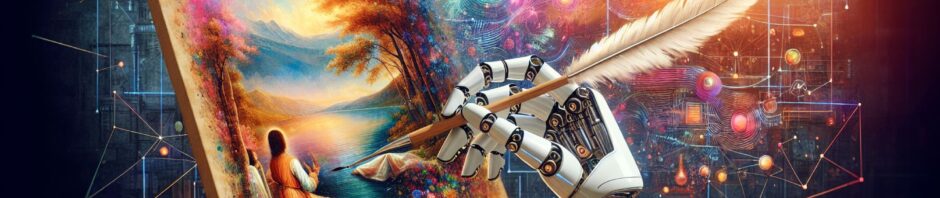
Welcome to a space where artificial intelligence meets the creative world, creating something entirely new in art and literature. In this post, I’ll explore the fascinating intersection of AI and creativity—a field that’s pushing the boundaries of what seems possible and making me wonder if we’re heading toward a tech-powered creative future.
The Dawn of AI-Creativity
A Historical Context
Creative AI isn’t just a buzzword; it’s a movement that many are calling the next Renaissance. Do you remember the first time you saw a computer create something beautiful? Whether it was drawing, writing, or composing music, artificial intelligence has been evolving at breakneck speed.
The journey started with basic programs that generated random art forms and has grown into today’s sophisticated neural networks. Thanks to machine learning, creative expression is no longer exclusively human territory. AI-generated works are showing up in art galleries, getting published in poetry collections, and being performed at music concerts. We’re watching an artistic revolution unfold.
What is AI-Creativity?
AI-creativity means using algorithms to produce art without direct human input. These algorithms, often using deep learning models, learn from massive datasets—everything from historical artworks to existing novels—helping them generate pieces that mimic or even challenge human creativity.
The Mechanics: How AI Generates Art
The Neural Network Revolution
In AI-art, the heart of the process is typically a neural network, specifically Generative Adversarial Networks (GANs) or Large Language Models (LLMs) for writing. In visual art, GANs have become popular for their ability to learn from enormous libraries of existing artwork and create original pieces that feel surprisingly human.
Each GAN has two parts: a generator and a discriminator. The generator creates images, and the discriminator evaluates them against real artwork. They work together, gradually improving the quality of the output until new pieces become nearly impossible to distinguish from human-made art.
Natural Language Processing and Artistry in Words
For written creativity, AI has mastered the art of weaving narratives through models like OpenAI’s GPT and Google’s BERT. These models consume text-based datasets, learning stylistic and structural patterns, then generate writings—from poetry to prose—that can evoke emotion and provoke thought.
With the latest GPT-4, the line between human and AI-written text often becomes blurred, creating a curious mix of admiration and uncanny uncertainty.
The Impact: AI as a Creative Collaborator
AI-Art in Mainstream Acceptance
From supplements to creators, AI tools have found their way into many designers’ and writers’ toolkits. Artists have started collaborating with AI to co-create art pieces that blend human skill and machine power, resulting in otherworldly, avant-garde art forms. A well-known example is AI-generated art being sold at traditional auction houses like Christie’s for astronomical amounts.
AI’s capacity for rapid creation is also giving artists endless possibilities. Want to create an entire book written by AI for different stylistic experiments? It’s becoming routine.
Democratizing Creativity
AI is also making art creation accessible to everyone. With platforms like DeepArt or RunwayML, anyone can create art without formal training. Educational platforms are using AI to teach complex writing and art techniques, making creative fields more approachable.
Developing regions that traditionally faced resource constraints in creative fields are now using AI to jumpstart their creative industries, adding a layer of global diversity to the arts.
Addressing Concerns: The Ethical Dimension
Intellectual Property and Ownership
Who owns an AI-generated artwork? This remains a thorny issue. Traditional copyright laws have no provisions for non-human creators, leading to legal confusion. While some argue that the creators of the algorithms should retain rights, others believe that the users guiding AI should share ownership.
Authenticity and Human Creativity
Skeptics worry that AI could drown out authentic human voices. If we can easily generate song lyrics or a Picasso-style painting, can genuine human creativity maintain its relevance or will it get lost in machine-generated content?
Educational institutions are starting to explore teaching creativity as a skill distinct from just producing artistic outputs, emphasizing the synthesis of ideas and emotional depth.
The Road Ahead: AI-driven Artistic Utopia?
A Symbiosis of Man and Machine
While AI’s entry into creative spheres may raise tough questions, it equally presents opportunities to redefine what it means to be an artist. Rather than replacing human creativity, AI expands the canvas for expression, inviting us to explore while embracing a partnership with machines.
Imagine a future where creative professionals brainstorm with AI collaborators in real-time. Architects design with AI-generated floor plans, while screenwriters iterate scripts with plot suggestions by AI, bringing dynamism and efficiency.
Technological Advancements and Continued Innovation
The playground of AI creativity is limitless, thanks to rapid technological progress. Quantum computing approaches, promising computational power that could supercharge AI’s creative abilities. Emerging neural networks will continue to evolve, enhanced with better datasets, offering higher quality artistic outputs.
Creative AI’s future could spur industries similar to the historical impact of the printing press or the internet, fundamentally altering cultural landscapes.
Conclusion: Artistic Renaissance Reinvented
As we navigate through the implications and possibilities of AI-centric artistry, one thing is clear—the fusion of technology and creativity is opening an exciting new chapter for both disciplines. This new Renaissance may challenge our definitions of art, but it also reminds us that creativity is essentially an ever-evolving dance between constraints and possibilities.
AI’s artistic endeavors spark discussions on value, authorship, and authenticity while making creative tools accessible to everyone. As AI continues to evolve, we’re at the edge of a fascinating era where human ingenuity and machine intelligence merge to craft new stories, sounds, and sights. Long live the new Renaissance—proof of the transformative power of AI-powered creativity.