The Moment a Huipil Transcended Fashion
There’s a particular quality of light in auction houses just before the gavel falls. It catches on surfaces in ways designed to make you notice things you might otherwise miss. In October 2025, that light fell on a Tehuana huipil—a traditional embroidered garment—that sold for $1.1 million at Sotheby’s New York. The price tag alone would make headlines. But what stopped me was the realization that we’ve finally arrived at a cultural moment where we understand what Frida Kahlo understood all along: that what we wear is not separate from what we paint, that cloth and canvas are siblings, that identity is not something we express through clothing but something we construct with it.
This wasn’t just a piece of fabric changing hands. It was an artifact that had lived against Kahlo’s skin, that had absorbed her presence and her choices. The auction represented something far more significant than market value—it was a reckoning with how we’ve historically dismissed the personal wardrobe as somehow less serious than fine art. And in doing so, it opened a conversation about legacy that extends well beyond the auction block.
Reading the Archives: What 6,000 Objects Tell Us
The Casa Azul in Coyoacán holds over 6,000 objects that belonged to Kahlo. These aren’t curiosities arranged for tourist photographs. They’re texts written in fabric, pigment, and carefully chosen detail. In 2024, the Museo Frida Kahlo Casa Azul completed a comprehensive digitization project funded by 800,000 dollars from Mexico’s National Institute of Fine Arts. The investment itself signals something important: we now recognize these objects as cultural patrimony worthy of institutional preservation and scholarly attention.
When you examine these archived pieces—not just photographically but through the meticulous documentation process that digitization requires—something emerges. You begin to understand that Kahlo’s wardrobe was neither random nor incidental. Each garment was a deliberate choice, a conversation partner to her paintings, a political statement wrapped around her body. The embroidery patterns, the Oaxacan textiles, the traditional Tehuana dress that became her visual signature—these weren’t nostalgic gestures. They were affirmations of Indigenous Mexican identity at a moment when such affirmations carried real risk.
Disability, Activism, and What We Wear
Dr. Circe Henestrosa’s 2025 research published in Fashion Theory examined fourteen photographic series to demonstrate something that reshapes how we see Kahlo’s choices. She documented how Kahlo used her wardrobe as deliberate activism around her disability. Those high-necked garments, the corseted constructions, the layered fabrics—they weren’t concealment strategies. They were structural support systems, architectural interventions on her own body, worn proudly and photographed repeatedly. This is the work of someone who refused to hide, who insisted on visibility on her own terms.
This reframing matters enormously. When we understand clothing as activism and adaptation rather than vanity or decoration, Kahlo’s closet becomes an extension of her artistic practice. She wasn’t getting dressed for the camera. She was creating art every time she left the house. The distinction might seem subtle, but it transforms everything. It means that what sold at Sotheby’s wasn’t a garment owned by an artist. It was art itself.
Contemporary Designers Learning to Read the Text
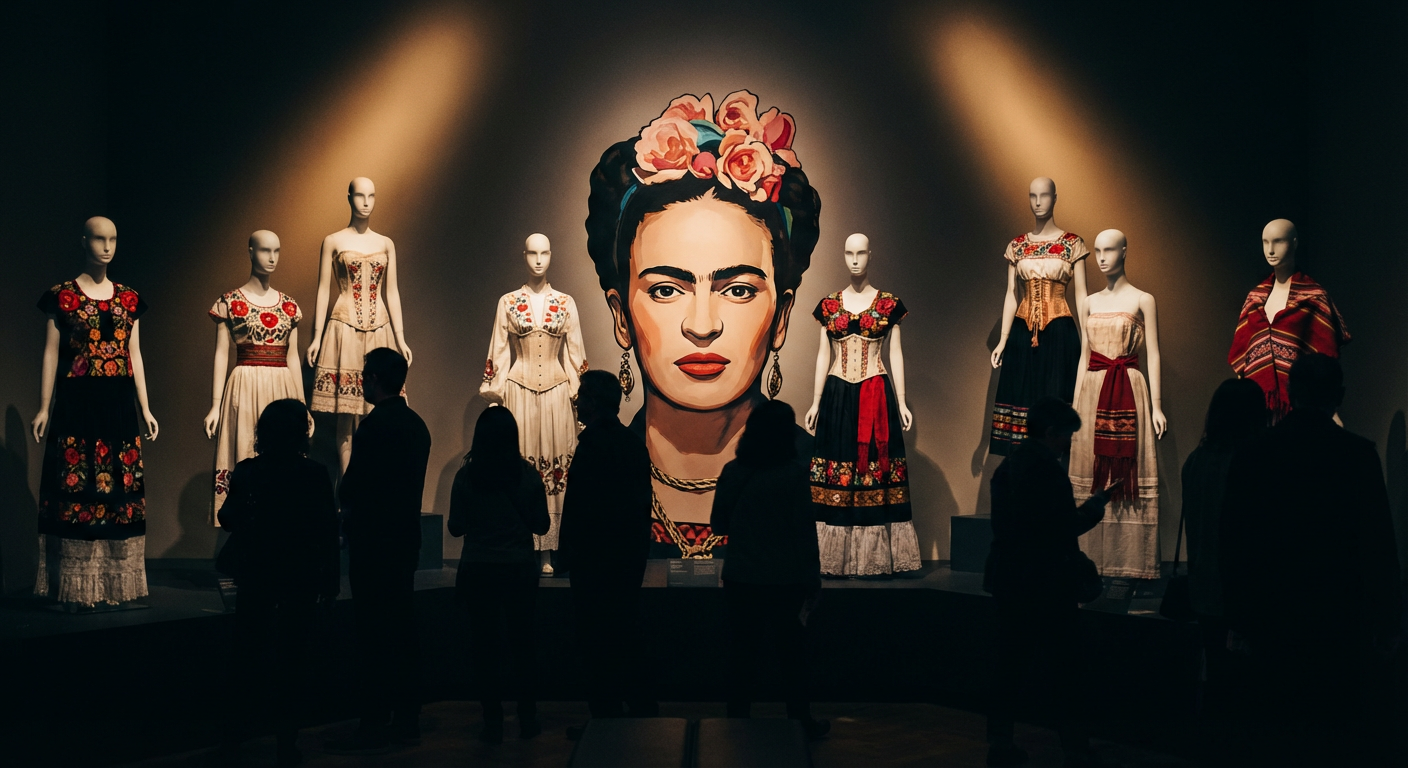
The influence has become undeniable. The Metropolitan Museum’s 2025-2026 exhibition “Fashioning Identity” dedicated an entire gallery to examining Kahlo’s impact on contemporary designers, and it drew 290,000 visitors in just eight weeks. This wasn’t nostalgia tourism. It was a masterclass in how historical figures reshape creative practice in real time. Designers walked into that gallery and saw something they perhaps hadn’t fully articulated before: that Kahlo’s integration of personal identity, cultural heritage, and political statement through clothing created a template for thinking about fashion as resistance.
Dries Van Noten, preparing his final collection before retirement, drew directly from the documented Oaxacan embroidery patterns in Kahlo’s wardrobe archive. Seven pieces. Seven direct references. Here was a designer at the height of his influence, at the symbolic conclusion of his career, choosing to spend that cultural capital engaging with Kahlo’s visual vocabulary. He wasn’t copying. He was acknowledging a lineage, saying: this woman showed us how to make cloth into argument, how to make the personal profoundly political.
Why This Moment Matters More Than We Might Realize
When a single garment sells for more than a million dollars, we tend to focus on the market mechanics. But that focus misses what’s actually happening. What we’re witnessing is a collective recognition that we’ve undervalued entire categories of human creative expression for centuries. We’ve separated the fine arts from the applied arts, the gallery from the closet, the canvas from the cloth. Kahlo spent her life collapsing these distinctions. Her paintings reference textiles. Her wardrobe echoes her paintings’ compositions. The line between wearable and viewable was never a line at all—it was always a false boundary drawn by institutions more comfortable with hierarchies than with integration.
This auction, these exhibitions, this scholarship—they’re not primarily about Kahlo. They’re about us. They’re about whether we’re finally ready to see that every choice about what we put on our bodies is a creative act, whether we understand that disability, identity, and activism can be expressed through fiber and thread just as powerfully as through paint and canvas. They’re about whether we can extend the same intellectual and emotional generosity to the textile arts that we’ve long reserved for painting and sculpture.
If you’re curious about where this conversation is heading, I’d encourage you to visit Metropolitan Museum Fashion Exhibitions or spend time with the Casa Azul’s digital archives. Look closely at how Kahlo constructed herself through fabric. Notice the repetition, the symbolism, the deliberate choices. Then look at your own wardrobe with the same attention you’d bring to a museum collection. Because that’s what Kahlo taught us: that we are all engaged in the continuous creative project of dressing ourselves into the world. What story are you stitching into existence today?